
What Is Lead Generation? (Meaning, Process, and 2026 Playbook)
 Rishabh Jain
TL;DR
Lead generation is the process of attracting, capturing, and qualifying potential customers (leads) and moving them toward a sale through content, offers, and outreach. In digital marketing, it turns anonymous demand into known contacts using forms, chat, ads, email, and product experiences, then scores, nurtures, and hands off the best opportunities to sales.
Why it matters: Better lead gen → lower CAC, higher conversion, healthier pipeline. It sits after demand generation (creating interest) and before lead management (routing, nurturing, closing).
Turning leads into booked deals comes down to the conversation. See how an AI sales call assistant helps reps on live calls, or compare the best AI sales tools.
Quick Definitions
Lead generation meaning / lead generation defined
Lead generation is the process of creating, maintaining, and converting prospect interest into identifiable contacts and qualified opportunities. It bridges the gap between marketing awareness and sales engagement, turning attention into action.
What is lead generation in digital marketing?
In digital marketing, lead generation means using online channels, such as SEO, content marketing, paid ads, email campaigns, social media, chatbots, and product trials to attract, capture, and qualify leads. The goal is to guide prospects from curiosity to conversion through value driven digital touchpoints.
What is lead generation in sales?
Lead generation in sales represents the frontend of the sales pipeline, identifying potential customers, qualifying their fit and intent, and handing off the most promising leads to account executives for further nurturing or closing. It’s where marketing efforts turn into tangible sales opportunities.
Lead generation vs. demand generation
While demand generation focuses on building broad brand awareness and interest, lead generation zeroes in on capturing and qualifying individuals who are actively ready to engage with your product or service. Together, they form the top layers of a modern digital marketing funnel, where demand creates attention, and lead generation converts it into measurable pipeline.
Types of Leads (and Where They Fit)
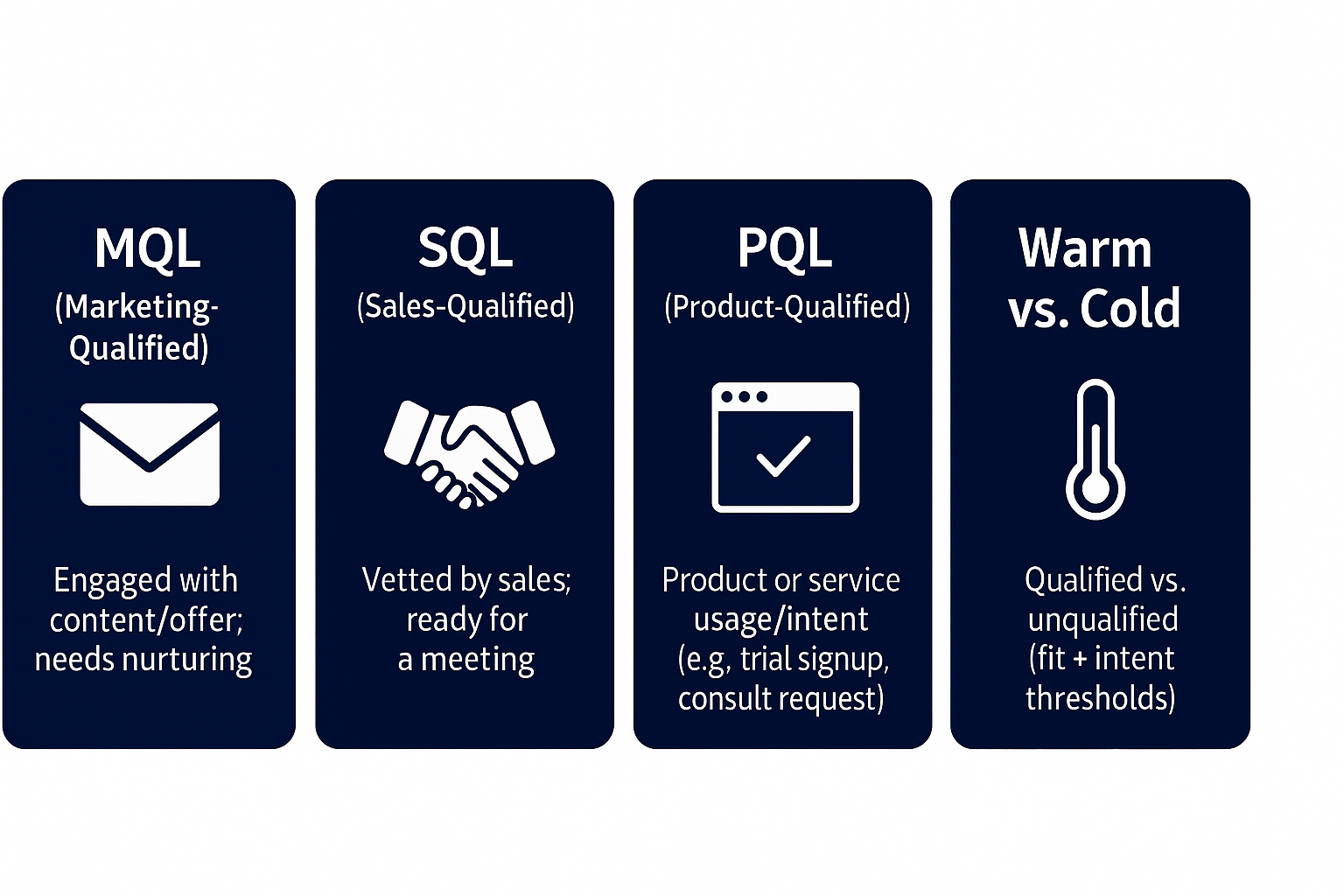
In lead generation, not all prospects are created equal. Each lead type represents a different stage of interest, engagement, and readiness to buy, helping marketing and sales teams align their outreach.
1. MQL (Marketing-Qualified Lead)
An MQL is a prospect who has interacted with your marketing efforts, downloaded a guide, attended a webinar, subscribed to a newsletter, or engaged with your content, and shows potential buying intent, but still needs nurturing before talking to sales.
Goal: Move from curiosity → conversation through targeted email sequences, retargeting, or educational content.
2. SQL (Sales-Qualified Lead)
An SQL has been vetted and approved by sales as ready for direct contact. They’ve expressed clear buying signals, such as booking a demo, requesting pricing, or responding positively to outreach, and meet your Ideal Customer Profile (ICP).
Goal: Schedule a discovery call or proposal discussion.
3. PQL / Service-QL (Product or Service-Qualified Lead)
A PQL (or Service-QL) comes from hands-on experience with your product or service. They might have signed up for a free trial, requested a consultation, or reached a milestone that indicates high intent (e.g., frequent feature use, upgrade inquiry).
Goal: Convert user engagement into a sales opportunity.
4. Warm vs. Cold Leads
Warm leads already know your brand, they’ve interacted with your website, content, or team.
Cold leads have had little to no prior contact and require awareness-building before conversion.
Similarly, leads can be qualified (fit your ICP and show intent) or unqualified (mismatch in budget, need, or timing).
What are leads in business? Leads are identified prospects who’ve shown interest in a company’s product or service through forms, demos, trials, emails, or events and can be qualified by marketing or sales for follow-up.
Lead Generation Methods (Inbound, Outbound & Hybrid)
Every business generates leads differently, but all strategies fall under three broad categories, inbound, outbound, and hybrid.
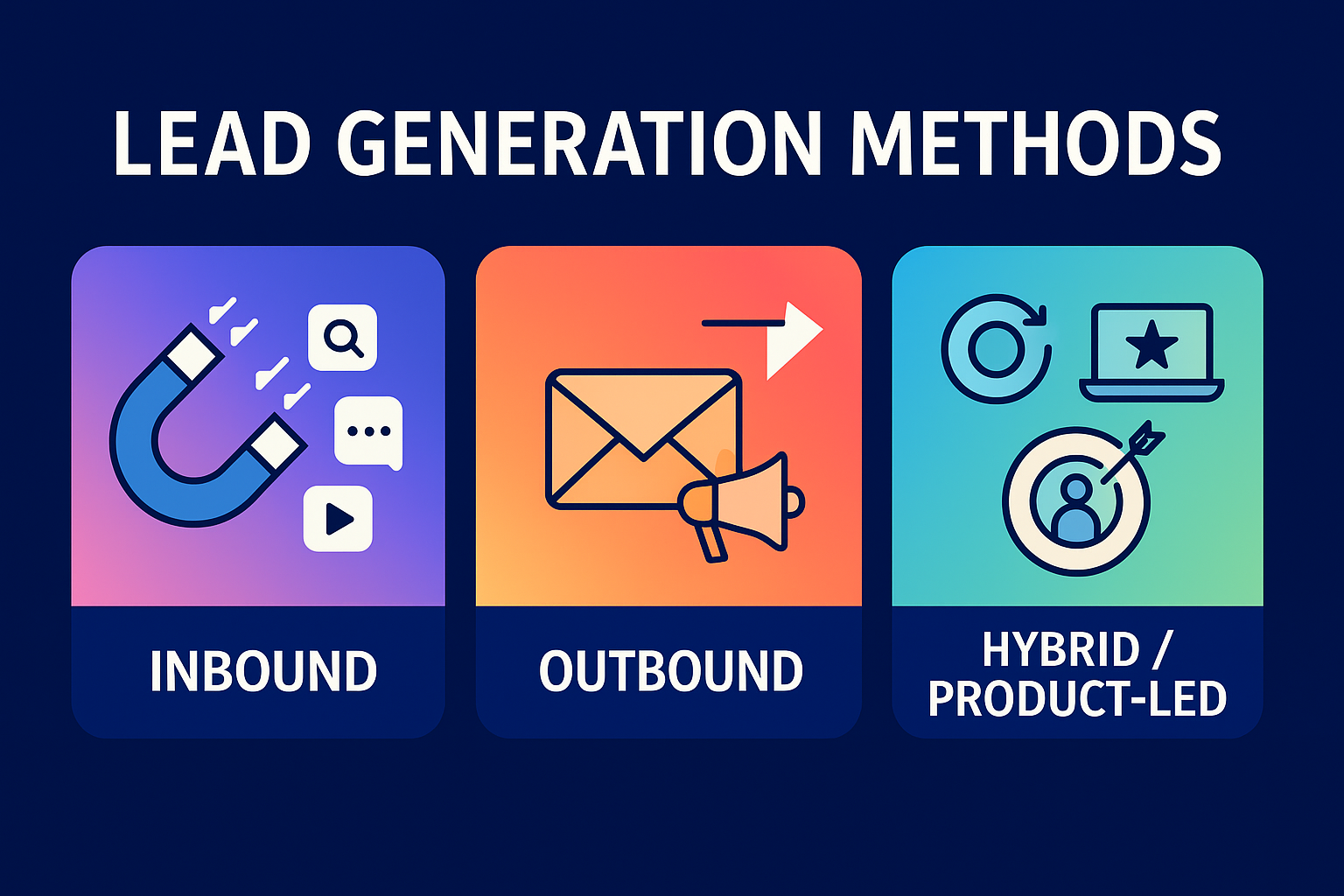
Understanding how they work together helps you build a predictable and scalable lead engine.
Inbound Lead Generation
Inbound lead generation focuses on attracting prospects naturally through valuable content and search visibility. Instead of pushing messages out, you pull audiences in by answering their questions, educating them, or offering useful tools.
Common inbound channels include:
SEO and content marketing (blogs, case studies, guides)
Search and social ads (Google Ads, LinkedIn Ads, YouTube pre-rolls)
Webinars and podcasts
Online communities and newsletters
Lead magnets (eBooks, templates, calculators, checklists)
Interactive tools and chatbots
Inbound leads come to you on their own timeline, often more informed and motivated. It’s slower to start but compounds over time — delivering sustainable, low-CAC growth.
Think of inbound as the magnet that pulls high-intent prospects directly into your funnel.
Outbound Lead Generation
Outbound lead generation is proactive — your team reaches out first. It’s perfect for testing new markets, targeting specific accounts, or driving short-term results when speed matters.
Common outbound tactics include:
Targeted ads (cold or non-retargeted)
Personalized email sequences and LinkedIn outreach
Cold calling and appointment-setting
Trade shows, conferences, and networking events
Direct mail or physical campaigns
Intent-data-driven outreach (targeting in-market companies)
Outbound gives you faster control and measurable testing, but success depends on accurate data, segmentation, and personalization. Done well, it fills the top of the funnel with precision.
Outbound is the engine that keeps your pipeline moving when inbound is still warming up.
Hybrid + Product-Led Lead Generation
Modern companies combine the best of both worlds, inbound nurture with outbound activation.
In this hybrid model, you:
Attract inbound leads via SEO, content, and social.
Retarget them with ads or email workflows.
Trigger sales outreach once fit and intent reach a certain threshold like PQL milestones (e.g., free-trial activation, repeated feature use, or pricing-page visits).
This product-led approach creates a seamless loop: content builds awareness → product builds trust → outbound accelerates conversion.
The future of lead generation isn’t inbound or outbound — it’s both, powered by intent signals and product data.
The Lead Generation Process (9 Steps)
Successful lead generation isn’t a one-off campaign — it’s a repeatable, data-driven system that moves prospects from awareness to revenue.
Here’s the nine-step process most high-performing sales and marketing teams follow:
1. Define ICP & Personas
Start by identifying your Ideal Customer Profile (ICP) — the industries, company sizes, and roles that are the best fit for your product.
Build buyer personas that capture their challenges, goals, and decision triggers.
Without a clear ICP, even the best campaigns waste budget.
2. Attract Traffic
Drive qualified visitors through SEO, PPC, social media, content collaborations, and partnerships.
Focus on visibility in the right intent stage — awareness, consideration, or decision — to bring in prospects who actually need your solution.
3. Capture Leads
Convert visitors into contacts using high-intent landing pages, forms, live chat, and lead magnets (templates, calculators, checklists, etc.).
Test different CTAs and placement strategies to maximize form-fill rates and lower cost per lead (CPL).
4. Qualify
Ask key questions around need, timeline, budget, and authority to determine fit.
Use lead scoring models combining demographic data (firmographics) and behavioral data (pages viewed, content downloaded) to prioritize leads worth pursuing.
5. Nurture
Feed prospects with automated email sequences, remarketing ads, or product-education content.
The goal is to build trust and readiness before passing them to sales.
6. Handoff (MQL → SQL)
Once a lead hits your qualification threshold, hand it off to sales.
Ensure context — campaign source, notes, and engagement history — is automatically synced to your CRM so sales can pick up the conversation seamlessly.
7. Convert
Sales engages through discovery calls, demos, trials, or proposals.
Tailor every touchpoint to the prospect’s stage, objections, and goals to improve close rates and shorten the sales cycle.
8. Analyze & Optimize
Track metrics like CPL (Cost per Lead), CVR (Conversion Rate), pipeline contribution, and ROI.
Use multi-touch attribution to understand which channels and messages drive the highest-quality leads, not just the cheapest clicks.
9. Retain & Expand
Lead generation doesn’t end at the sale. Continue with onboarding, lifecycle campaigns, and upsell opportunities to grow customer value and encourage referrals.
Retention is the final — and most profitable — phase of the lead generation cycle.
This nine-step framework mirrors how leading platforms like Salesforce, Adobe, and Oracle structure their customer-acquisition journeys — from creating interest to conversion and lifetime ROI measurement.
Lead Generation Marketing Strategies (2026)
Lead generation in 2026 is no longer about filling forms — it’s about meeting buyers where they already research, engage, and decide.
Modern strategies combine SEO, content, automation, and intent data to attract, qualify, and convert the right prospects faster.
1. Search Engine Lead Generation
Search is still the most powerful lead source — but success today requires depth and authority, not just keywords.
Build topic clusters, create glossary pages around key terms like “lead scoring” and “buyer intent”, and publish “best tools” comparisons or step-by-step buyer guides with embedded CTAs.
Why it works: search intent is high, conversion rates are strong, and content compounds over time.
2. Content Marketing for Lead Generation
Educational content remains the backbone of inbound lead gen. Offer templates, calculators, ROI checklists, and interactive graders that help users take immediate action.
Every piece should lead to a conversion path — a gated download, product trial, or demo CTA.
Example: A “Lead Scoring Calculator” converts visitors directly into qualified MQLs.
3. Online Marketing Lead Generation
Blend SEO, PPC, social media marketing, and community engagement to stay visible across channels.
Communities (LinkedIn groups, Reddit, Slack, or Discord spaces) help establish authentic brand authority, while paid channels like Google Ads and Meta Ads accelerate reach and data collection.
Tip: Pair paid campaigns with organic nurture for full-funnel coverage.
4. Email Lead Generation
Email remains one of the highest-ROI channels for lead nurturing and conversion. Use gated content, double opt-ins, and preference centers to collect consented, high-quality leads.
Segment based on behavioral intent and automate journeys that respond to engagement triggers (e.g., pricing-page visits or whitepaper downloads).
5. ABM & Intent Data
Account-Based Marketing (ABM) paired with intent data helps prioritize in-market accounts showing buying signals (like content consumption or competitor research).
Tools like Cognism and 6sense enable hyper-personalized outreach by stage and persona.
Think quality over quantity — engage fewer, higher-fit accounts with deeper context.
6. Product-Led & PQL Strategies
A product-led growth (PLG) approach turns usage into the new conversion funnel. Free trials, freemium models, or sandbox demos help users experience value before buying.
Track PQL milestones, feature adoption, activation events, or upgrade attempts — and alert sales teams in real time.
Start with one “hero” conversion goal per page, demo, free trial, or template download.
Fewer CTAs mean clearer intent signals and higher conversion rates.
Measurement & KPIs (Lead Generation Analytics)
You can’t improve what you don’t measure — and in lead generation, data is your best performance compass.
The goal isn’t just more leads, but better-quality leads that move efficiently through the funnel and deliver predictable ROI.
Core Lead Generation Metrics
KPI | What It Measures | Why It Matters |
|---|---|---|
CPL (Cost per Lead) | Total spend ÷ number of leads generated | Tracks acquisition efficiency; helps benchmark paid vs. organic ROI. |
MQL → SQL → Win Rates | Percentage of leads that progress through each stage | Reveals lead quality and sales-marketing alignment. |
Pipeline Generated | Total revenue opportunity created from new leads | Measures the true output of lead generation, not just volume. |
Payback / CAC | Cost to acquire a customer vs. return timeline | Ensures profitability and sustainable spend ratios. |
Lead Quality Score | Weighted model combining fit (ICP) + intent (behavior) | Prioritizes high-value leads and reduces wasted sales time. |
ROI (Revenue ÷ Spend) | Return on lead generation investment | The ultimate metric tying marketing performance to revenue. |
Velocity (Days to Opportunity) | Average time from lead creation to qualified opportunity | Shorter velocity = stronger funnel efficiency. |
How to Read the Data
Map each KPI to a funnel stage (Awareness → Interest → Decision → Conversion).
Balance quantity with quality — a low CPL means little if your MQL→SQL rate collapses.
Track both conversion speed (velocity) and conversion value (pipeline ROI).
Implement multi-touch attribution to understand which channels or campaigns contribute most to conversions.
Build dashboards that visualize stage-by-stage performance, not just top-line totals.
Don't just stop at “CPL” or “conversion rate.” The real edge comes from tracking lead velocity, pipeline ROI, and quality scoring, where marketing ops and sales intelligence intersect.
Optimization Playbook (Improve Lead Generation Fast)
Once your lead generation system is running, the next step is continuous optimization — fine-tuning every touchpoint to capture higher-quality leads with less friction.
These quick wins can dramatically improve conversion rates, pipeline velocity, and ROI.
1. Match Search Intent on Every Page
Ensure each landing page and blog post aligns with the user’s intent —
Informational: teach and nurture (blogs, glossaries, explainers)
Transactional: capture and convert (demos, templates, calculators)
When intent and content match perfectly, your conversion rates spike and bounce rates drop.
Pro Tip: Map every page in your funnel to an intent type and CTA that fits it.
2. Upgrade Your Offers
Replace low-value CTAs like “Join our newsletter” with high-value assets that solve real problems.
Think: calculators, teardown reports, templates, or free mini-tools.
Specificity builds trust and urgency.
Example: “Get your 7-step sales call teardown” converts far better than “Subscribe for updates.”
3. Reduce Friction
Shorten your forms — only ask for what you actually use.
Add social logins, auto-fill, or magic links for easier sign-ups.
The less effort required, the higher your completion rate.
Small tweak, big result: Cutting just one form field can boost conversions by 26%.
4. Speed & UX Matter
Slow pages kill intent. Optimize for Core Web Vitals, use lazy-loaded chat widgets, and make sure every landing page is mobile-first.
Lead gen tools (forms, modals, chat) should never block key content or CTAs.
Mobile optimization = 60% of your leads.
5. Tighten Routing SLAs
High-intent leads lose interest fast.
Set instant alerts for demo requests and aim for under 5 minutes from submission to first response.
Faster follow-ups can triple conversion likelihood.
Speed-to-lead = revenue.
6. Run Lifecycle Experiments
Test and iterate constantly — experiment with subject lines, send times, content sequences, and retargeting frequency.
Use A/B testing to refine nurture flows and identify what truly moves leads to the next stage.
7. Score Smarter
Move beyond basic scoring.
Use a 3-dimensional model that weighs:
Behavior: page depth, downloads, repeat visits
Fit: firmographics, technographics
Intent: topics consumed, feature interest
Smart scoring helps your sales team focus where intent meets opportunity.
8. Align With Sales
Optimization doesn’t stop at marketing.
Create shared definitions for MQLs and SQLs, establish feedback loops, and track loss reasons inside your CRM.
When sales and marketing speak the same language, close rates climb.
Alignment turns a funnel into a flywheel.
Common Challenges to Avoid
Even the best lead generation strategies can fail if the fundamentals are off.
Here are the most common pitfalls that limit performance — and how to fix them before they drain your pipeline.
1. Vague ICP (Ideal Customer Profile)
Without a precise ICP, you’ll attract the wrong audience. Define who you sell to, their pain points, and buying triggers before running campaigns.
Fix: Document 2–3 primary personas with clear fit criteria and decision signals.
2. Generic Content & Weak CTAs
Content that feels generic won’t convert. Avoid surface-level blogs or unclear offers. Every piece should lead to a specific, valuable next step.
Fix: End every article or page with one high-intent CTA — demo, template, or calculator.
3. Ignoring Mobile Speed & UX
Slow load times and cluttered layouts kill conversions. More than half of B2B and e-commerce development services in Australia now come from mobile devices.
Fix: Optimize Core Web Vitals, compress images, and test every form on mobile.
4. Over-Reliance on One Channel
Depending too heavily on a single platform (like paid ads or email) leaves you vulnerable to algorithm changes or rising costs.
Fix: Diversify, combine SEO, email, paid, and community-driven inbound for balance.
5. Misaligned MQL/SQL Handoffs
If marketing and sales disagree on what qualifies as a lead, opportunities get lost.
Fix: Set shared definitions, track stage conversions, and hold joint reviews to refine handoff quality.
6. Under-Instrumented Analytics
You can’t optimize what you can’t measure. Many teams fail to track lead velocity, conversion stages, or ROI properly.
Fix: Build dashboards that show stage-by-stage progression — not just total leads.
7. Quantity Over Quality
Buying contact lists or chasing volume leads to poor data hygiene, low engagement, and damaged deliverability.
Fix: Focus on fit, intent, and consent. Fewer, higher-quality leads outperform big, cold lists every time.
Great lead generation isn’t about more leads, it’s about qualified leads, clean data, fast follow-ups, and aligned teams.
Lead Generation vs. Lead Management vs. Demand Generation (Distinctions)
Function | Primary Goal | Key Activities | Stage in Funnel | Example |
|---|---|---|---|---|
Demand Generation | Build awareness and trust among a broad audience | Brand storytelling, content marketing, webinars, ads, community building | Top of Funnel (Awareness) | Publishing a thought-leadership article or hosting an educational webinar |
Lead Generation | Capture and qualify identifiable prospects who show buying intent | Landing pages, forms, lead magnets, demos, trials | Middle of Funnel (Consideration) | Collecting emails from visitors who download a free guide or request a demo |
Lead Management | Nurture and advance qualified leads through the sales cycle | Scoring, CRM routing, follow-ups, remarketing, lifecycle emails | Bottom of Funnel (Decision → Conversion) | Passing MQLs to sales, tracking engagement, and converting SQLs into customers |
Quick Summary:
Demand generation creates attention.
Lead generation converts interest into contacts.
Lead management turns contacts into paying customers.
Examples (What Does a Lead Generator Do?)
Lead generation looks different across industries, but the goal is always the same — attract the right people, capture their details, and move them closer to a sale.
Here are a few practical examples of how lead generation works in different contexts:
Industry / Use Case | Lead Generation Flow | Objective |
|---|---|---|
Ecommerce | Interactive quiz → personalized product bundles → instant discount code → automated email/SMS flow | Increase conversions through personalization and first-purchase incentives |
B2B SaaS | Comparison page → ROI calculator → demo booking → PQL trigger during free trial | Capture high-intent prospects and transition them from product use to sales engagement |
Consumer Services | Local service finder → instant quote form → call scheduling | Convert online visitors into scheduled appointments quickly |
IT / Tech Sales | Intent-topic tracking + technographic filters → personalized outbound messaging | Target in-market accounts with relevant tech stacks or buying signals |
Best Example of Lead Generation:
A demo-request landing page with a short form, clear value proposition, social proof, and a follow-up within five minutes remains the highest-intent and most effective B2B lead generation model today.
Tools & Stack (Lead Generating Systems)
The right tech stack transforms lead generation from manual effort into a scalable, data-driven engine.
Below is a breakdown of the core systems every modern revenue team should have in place:
Tool Category | Core Function | What It Enables | Example Tools / Platforms |
|---|---|---|---|
CRM & Pipeline Management | Capture, deduplicate, and route leads automatically; track deal stages and attribution. | Keeps marketing and sales aligned, ensures no lead slips through the cracks. | HubSpot CRM, Salesforce, Pipedrive, Zoho CRM |
Marketing Automation | Score leads, nurture them through journeys, trigger actions based on behavior or timing. | Builds relationships at scale and improves conversion velocity. | HubSpot, Marketo, ActiveCampaign, Customer.io |
Sales Intelligence & Data | Access firmographics, technographics, and intent signals for better targeting. | Helps sales prioritize in-market accounts and personalize outreach. | Cognism, ZoomInfo, Apollo, Clearbit |
Attribution & Analytics | Track performance across channels and campaigns using multi-touch models. | Reveals which sources, keywords, or assets truly drive ROI. | Google Analytics 4, Dreamdata, Wicked Reports, HubSpot Attribution |
Call-Stage Assistance | Provide real-time prompts, objection handling tips, and post-call insights for reps. | Improves call quality, close rates, and coaching opportunities. | SalesEcho, Gong, Lavender, Fireflies.ai |
A connected stack — CRM + automation + intelligence — creates a closed feedback loop from first click to closed deal.
Add call-stage AI like SalesEcho to unlock real-time coaching and insight during every conversation.
Related: Best AI Sales Call Assistants
FAQ
1. Is lead generation a BPO?
Not by default. BPO (Business Process Outsourcing) refers to contracting external teams to handle business functions.
Some companies outsource lead generation, for example, appointment-setting or data enrichment—but lead generation itself is a core marketing and sales function that can be managed in-house or by an agency.
2. What is the best example of lead generation?
A demo-request landing page with:
a short, friction-free form,
a clear value statement (“See how our tool saves 4 hours a week”),
strong social proof (logos, testimonials), and
a follow-up within five minutes
is still the gold-standard B2B lead generation example.
3. What is lead generation in SEO?
Lead generation in SEO means using search-optimized content to attract visitors who are actively researching your solution—then converting them through forms, lead magnets, or chatbots.
Think “topic clusters,” comparison pages, and how-to content that capture both informational and transactional intent.
4. Is lead generation a KPI?
Not exactly. Lead generation is the program or activity, while KPIs are the metrics that measure its performance—for example:
CPL (Cost per Lead)
MQL→SQL conversion rate
Pipeline contribution
ROI (Revenue ÷ Spend)
5. Is lead generation part of CRM?
Yes—your CRM (Customer Relationship Management) platform is the central system that stores, routes, and tracks leads.
It connects marketing data (forms, emails, campaigns) with sales activity (calls, demos, deals) to ensure nothing gets lost in the handoff.
6. Is lead generation a skill?
Absolutely. Effective lead generation blends skills in copywriting, analytics, sales funnel design, data hygiene, and b2b sales alignment.
Top performers know how to combine creative storytelling with technical automation and measurement.
7. Why is lead generation important to businesses?
Because it directly fuels pipeline growth, revenue predictability, and CAC efficiency.
Without a structured lead-gen system, sales teams rely on chance instead of a steady flow of qualified opportunities.
Conclusion
Lead generation isn’t just about collecting emails — it’s about building consistent, high-quality pipelines that turn curiosity into conversations and conversations into customers.
From demand creation to lead capture, nurture, and sales handoff, every step matters — and small improvements in speed, targeting, or messaging can dramatically shift your ROI.