
Sales Funnel — Strategy, Stages & Smart Automation
 Rishabh Jain
TL;DR
A sales funnel maps how buyers move from awareness to purchase — helping you track conversions and fix leaks.
The five key stages are: Awareness → Consideration → Decision → Purchase → Loyalty/Expansion.
Strong funnel management = higher deal velocity, predictable revenue, and shorter sales cycles.
Use tools like SalesEcho to streamline every stage — from live call guidance to post-call insights.
Focus on data, automation, and AI to build a funnel that learns, adapts, and scales with your business.
Mastering the Sales Funnel: From Leads to Deals to Growth
In today’s hybrid world of AI-driven sales, SaaS products, and self-educating buyers, the classic sales funnel has evolved. No longer a simple linear path, it’s a dynamic ecosystem where marketing, sales, and customer success intersect to guide prospects from first touch to lasting loyalty.
Once leads reach the call stage, execution matters. An AI sales call assistant coaches reps live, and you can compare the top AI sales tools to find the right fit.
A sales funnel is the visual roadmap that shows how potential customers move through your buying process from discovering your brand to becoming repeat customers. It helps you identify where leads drop off, which tactics convert best, and how to predict revenue with accuracy.
Why it matters? Because in 2026, buyers research independently, jump between channels, and expect instant, personalized help. The companies winning the game are the ones using AI powered funnel management, analyzing every stage, automating handoffs, and giving reps real-time insights.
What a Sales Funnel Is & How It Works
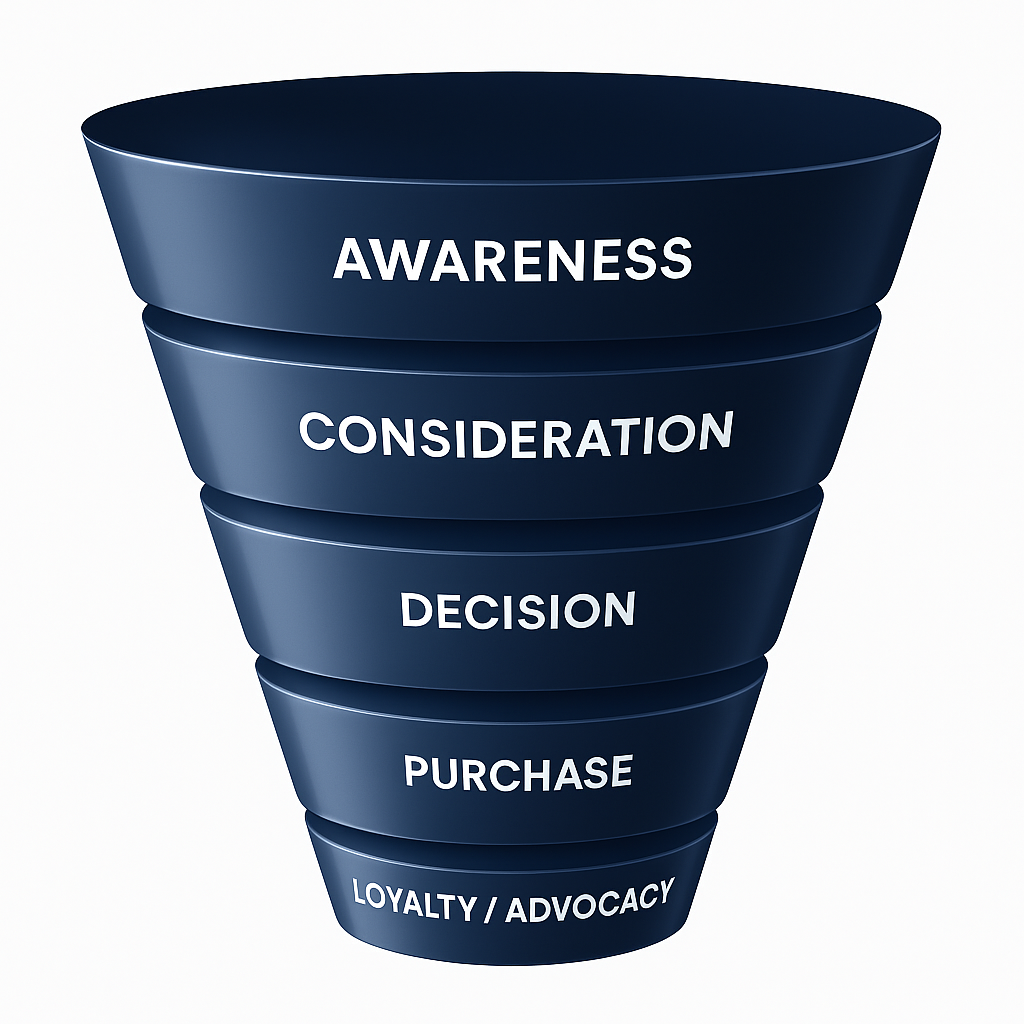
A sales funnel is a step-by-step model that visualizes how potential buyers move from awareness to purchase. Think of it as a conversion map, showing where leads enter, how they engage, and what percentage advance to the next stage. The shape of the funnel narrows because, at every step, some prospects drop off while others move closer to becoming customers.
Funnel vs. Pipeline vs. Customer Journey
Aspect | Sales Funnel | Sales Pipeline | Customer Journey |
|---|---|---|---|
Focus | Buyer’s progression through awareness, consideration, and decision stages. | Seller’s activities such as outreach, demos, proposals, and deal closure. | Every interaction a customer has with your brand—from discovery to advocacy. |
Primary Goal | Measure conversion rates and identify where leads drop off. | Track sales actions and forecast upcoming revenue. | Optimize experience and satisfaction throughout the entire lifecycle. |
Perspective | Buyer-focused — how leads move through decision-making. | Seller-focused — what the sales team does to close deals. | Customer-focused — what users feel, expect, and experience. |
Ownership | Shared between marketing and sales. | Primarily sales and revenue teams. | Shared across marketing, sales, and customer success. |
Duration | Ends at conversion or purchase. | Ends at deal closure. | Continues through onboarding, retention, and loyalty. |
In short:
The funnel measures how well you convert.
The pipeline tracks what your team is doing.
The journey shows what your customer experiences.
Together, they create a full-view system for scaling predictable revenue.
Why Sales Funnel Management Is Essential
Without clear funnel management, teams chase the wrong leads, overlook qualified buyers, and can’t forecast accurately. A healthy funnel ensures your marketing and sales are aligned, your stages are well-defined, and your data drives decisions, not guesswork.
Modern sales teams now use AI powered funnel management to:
Identify leaks in real time.
Prioritize high-intent leads.
Coach reps using conversation insights.
Automate repetitive steps like follow-ups and reporting.
Typical Sales Funnel Stages Explained
A well-structured sales funnel follows a predictable series of stages that move a potential customer from awareness to long-term loyalty. While every business adapts these steps to fit its own model, the framework below outlines the most widely used approach.
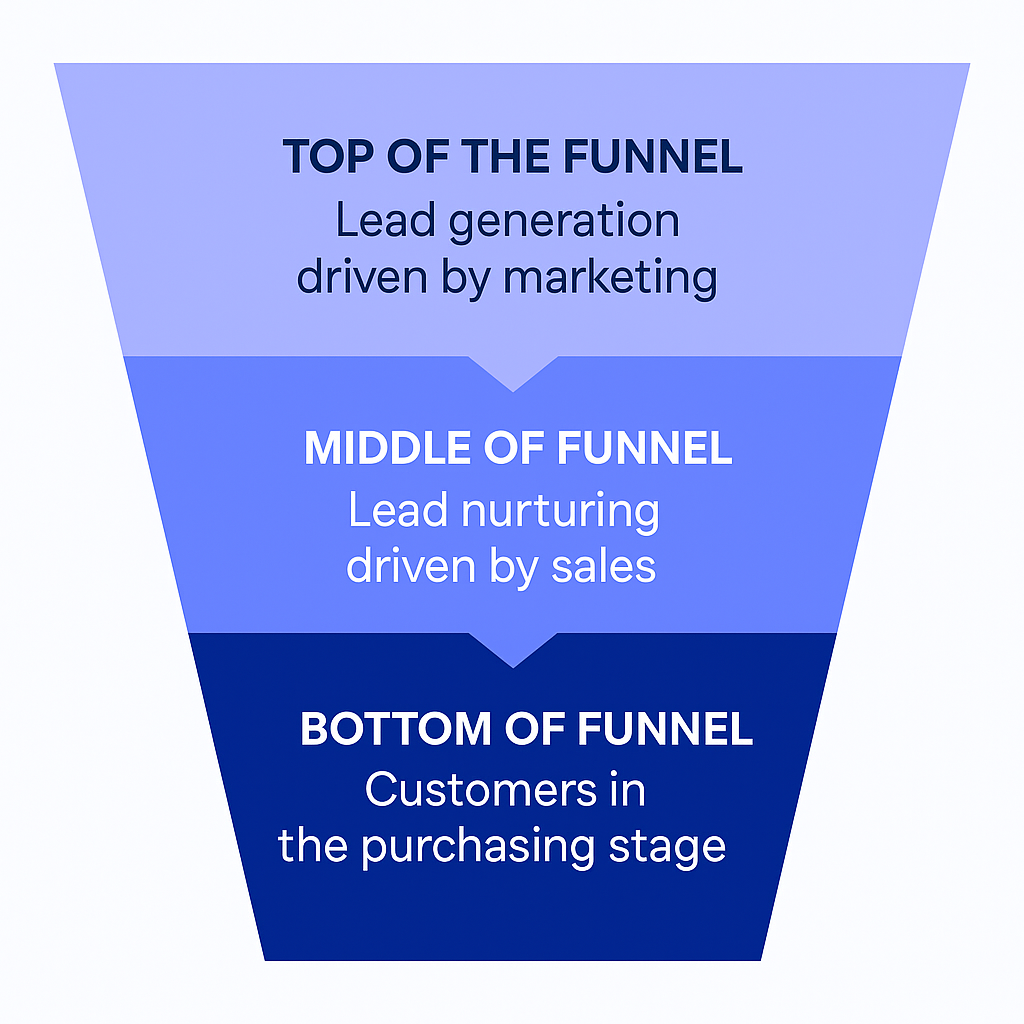
1. Awareness (Top of the Funnel / TOFU)
This is where prospects first discover your brand, product, or solution. They may be researching a problem, exploring trends, or comparing general options. The goal at this stage is not to sell but to educate and attract attention.
Common TOFU strategies include:
Content marketing (blogs, videos, and SEO guides)
Paid and organic social media campaigns
Webinars, podcasts, or community engagement
Search engine optimization targeting informational intent
Strong TOFU performance fills your funnel with qualified, problem-aware leads who can be nurtured further down the line.
2. Consideration (Middle of the Funnel / MOFU)
In the consideration stage, prospects understand their problem and are evaluating possible solutions. They’re comparing providers, reading reviews, or testing free trials. Your job here is to build trust and authority by showing that your product or service is the best fit.
Typical MOFU tactics include:
Case studies, customer stories, and testimonials
Product demos or interactive walkthroughs
Whitepapers, webinars, or comparison guides
Lead nurturing through targeted email sequences
A clear qualification process—such as BANT, MEDDIC, or SPICED—helps ensure your team focuses on the right opportunities at this stage.
3. Decision (Bottom of the Funnel / BOFU)
Here, prospects are ready to buy but may need reassurance before committing. The decision stage focuses on reducing risk, reinforcing value, and closing with confidence.
Effective BOFU strategies include:
Personalized demos or pilot programs
Transparent pricing, ROI calculators, or proof-of-concept offers
Negotiation support, proposal documents, and social proof
Collaborative plans or limited-time incentives to finalize deals
The goal is to make the buyer’s final step frictionless and backed by trust.
4. Purchase & Beyond (Onboarding → Retention → Expansion → Advocacy)
Once a deal closes, the funnel doesn’t end—it transforms into a cycle of retention and growth. The post-purchase experience determines whether customers stay, upgrade, and refer others.
Focus areas include:
Smooth onboarding and clear success milestones
Regular check-ins and personalized support
Loyalty programs, cross-sell and upsell campaigns
Encouraging reviews, referrals, and brand advocacy
Strong post-purchase management turns one-time buyers into long-term brand champions and predictable recurring revenue.
Variants Across Different Business Models
B2B funnels typically involve multiple stakeholders and longer decision cycles. Relationship-building, demos, and ROI proof are key.
SaaS funnels often emphasize free trials, activation metrics, and retention-driven upsells. Product experience plays a major role.
Service business funnels focus on credibility, proposal quality, and trust. Client testimonials and past work carry more weight than price.
Enterprise funnels are highly consultative and require multi-threaded outreach, executive alignment, and proof of long-term value.
Regardless of the model, each variant shares a common principle: align marketing, sales, and customer success around the buyer’s journey, then measure and optimize at every stage.
Sales Funnel Process Steps & Best Practices
A successful sales funnel isn’t just a diagram—it’s a system that runs on clear structure, consistent review, and collaboration between marketing, sales, and customer success. Below are the key steps and proven best practices for building and managing an effective funnel.
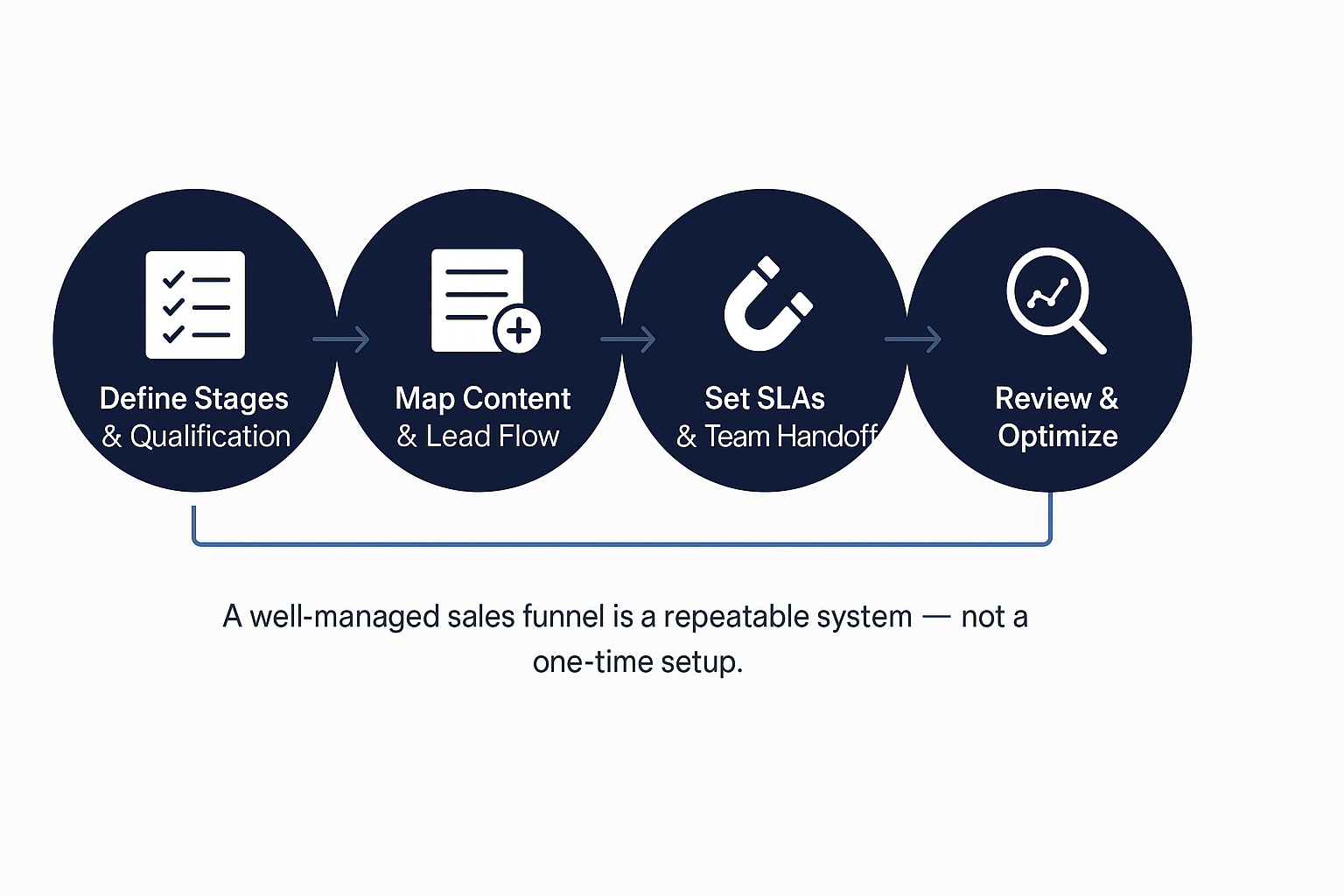
1. Define Stages, Exit Criteria, and Qualification Standards
The foundation of strong funnel management is clarity. Each stage—from awareness to purchase—should have specific entry and exit criteria so everyone knows when a lead is ready to move forward.
For example:
Marketing Qualified Lead (MQL): Has engaged with at least two pieces of content and fits your ICP.
Sales Qualified Lead (SQL): Has confirmed budget, need, and timeline.
Opportunity: A clear buying intent with decision-maker involvement.
Defining these criteria prevents guesswork, ensures accurate forecasting, and creates accountability. Qualification frameworks such as BANT, MEDDIC, or SPICED help teams stay objective when scoring leads.
2. Map Content, Offers, and Lead Generation (Filling the Funnel)
Once your stages are clear, map the content and offers that attract and convert leads at each level.
Top of the Funnel (TOFU): Blog posts, guides, podcasts, and social content that educate and attract.
Middle of the Funnel (MOFU): Case studies, comparison pages, and webinars that build trust.
Bottom of the Funnel (BOFU): Demos, trials, and ROI calculators that drive action.
Your goal is to fill the funnel with quality leads, not volume alone. Every asset should guide the buyer toward a measurable next step—download, meeting, signup, or purchase.
3. Set SLAs and Handoffs Between Teams
Misalignment between marketing, sales, and customer success often leads to wasted leads and slow follow-up times. To fix this, establish Service Level Agreements (SLAs) that define responsibilities at each stage.
Examples:
Marketing must pass only leads that meet MQL criteria.
Sales must contact new SQLs within 24 hours.
Customer success must onboard new clients within five business days.
This structure reduces friction, improves accountability, and keeps your funnel moving smoothly from awareness to advocacy.
4. Review the Funnel Regularly and Optimize Conversion
Funnels are not static—they require constant monitoring and refinement. Hold weekly or monthly funnel reviews to identify where prospects drop off and why.
Focus on key areas like:
Funnel leaks: Stages where conversion rates dip below benchmarks.
Velocity: How long deals stay in each stage.
Lead quality: Whether marketing and sales definitions are still aligned.
Use data from analytics tools, CRMs, and conversation intelligence platforms to find patterns and adjust campaigns, messaging, or qualification logic. Even a small lift in stage-to-stage conversion can significantly improve overall revenue performance.
Best Practice Summary
Define clear stage criteria and qualification rules.
Align content and offers with buyer intent.
Formalize SLAs between departments.
Audit performance regularly and fix leaks early.
When these steps are implemented consistently, your funnel becomes more predictable, scalable, and resilient—no matter how complex your sales process grows.
Sales Funnel Metrics, Analysis & Optimization
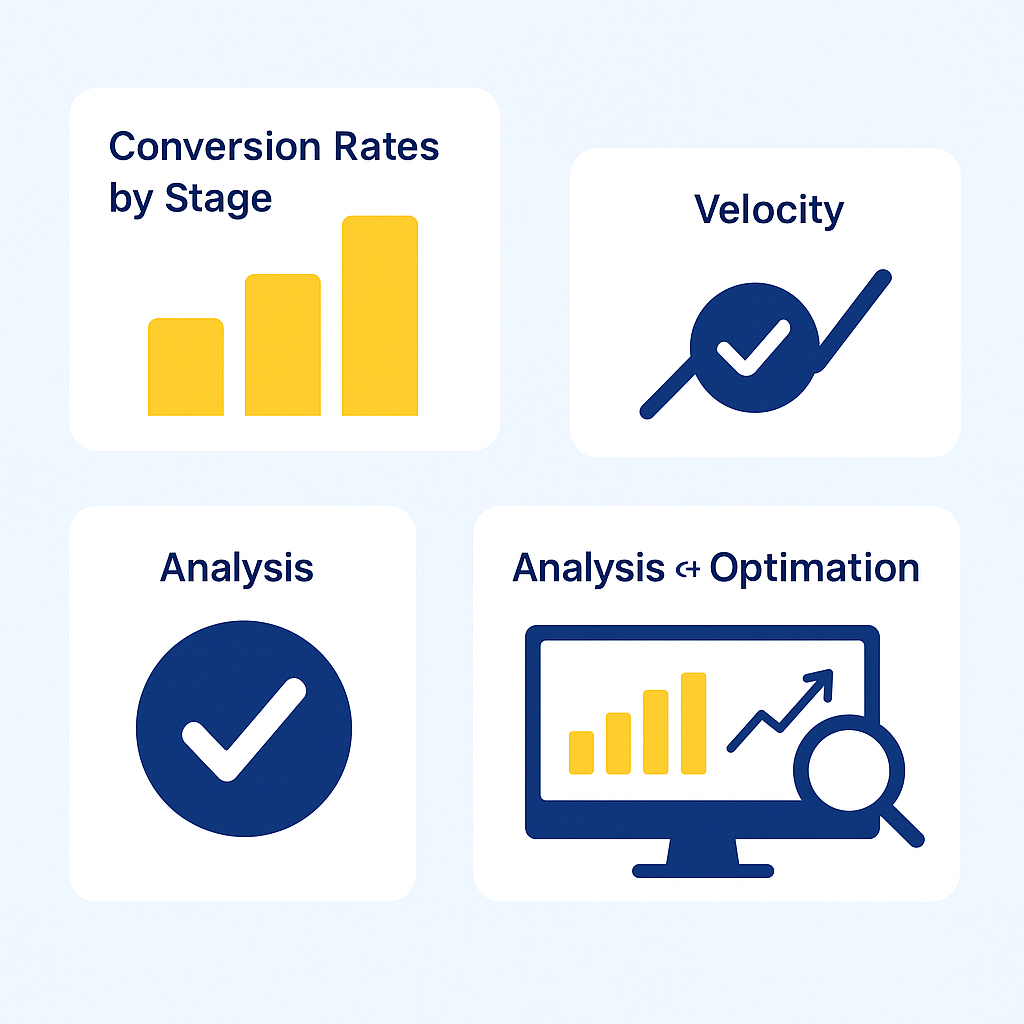
Tracking the right metrics is what transforms a sales funnel from a theoretical model into a measurable growth engine. Metrics show how efficiently prospects move from one stage to the next, where bottlenecks appear, and what tactics are driving real results.
By consistently analyzing your funnel, you can uncover opportunities to improve conversion rates, shorten sales cycles, and increase overall revenue predictability.
1. Key Metrics to Monitor
A healthy funnel depends on a few core metrics that together reveal performance across every stage:
Stage-to-stage conversion rate: The percentage of leads that advance from one stage to the next.
Win rate: The percentage of total qualified opportunities that result in a closed deal.
Sales velocity: Measures how quickly revenue moves through your pipeline.
Formula:
Velocity = (Number of Opportunities × Average Deal Size × Win Rate) ÷ Sales Cycle Length
Lead-to-customer ratio: Indicates overall funnel efficiency and marketing-to-sales alignment.
Time-in-stage: Helps identify where prospects are stalling and where follow-up is needed most.
Funnel value: The total potential revenue sitting at each stage, useful for forecasting and prioritization.
2. Benchmarks and Formulas for Comparison
While every business has unique performance standards, benchmarks help you gauge your funnel’s health:
Metric | Healthy Benchmark Range (B2B / SaaS) |
|---|---|
Lead → MQL | 25–35% |
MQL → SQL | 15–25% |
SQL → Opportunity | 40–60% |
Opportunity → Closed Won | 15–30% |
Overall Win Rate | 20–25% average |
Sales Velocity | Increases 10–20% with regular funnel optimization |
Use these numbers as reference points, not rigid goals. The most important benchmark is your own trend over time—steady improvement beats static perfection.
3. Tools, Dashboards, and Automation
Modern sales teams rely on integrated tech stacks to visualize and optimize funnel performance.
CRM platforms (HubSpot, Salesforce, Pipedrive): Track lead progress, conversion, and revenue metrics.
Analytics dashboards (Google Data Studio, Tableau, Power BI): Consolidate funnel data into visual insights.
Marketing automation tools (ActiveCampaign, HubSpot, Encharge): Automate nurturing and scoring to maintain funnel momentum.
Conversation analytics & call intelligence: Identify objections, intent signals, and deal risks from real interactions.
AI-powered insights: Tools that automatically flag stalled deals, predict conversion likelihood, and recommend next actions.
Automation helps maintain speed and consistency, while AI insights surface patterns humans might overlook—allowing your team to act faster and smarter.
4. Example: Using AI Assistance to Boost Funnel Conversion
Imagine a sales team analyzing their funnel and discovering that 40% of qualified leads stall between the demo and proposal stages. After integrating an AI-powered assistant, reps start receiving real-time conversation insights—objection cues, sentiment shifts, and follow-up prompts.
Within weeks:
Stage velocity improves by 18%.
Win rate increases by nearly 10%.
Sales managers gain visibility into where deals slow down and why.
This example illustrates how AI assistance doesn’t replace sales teams—it enhances human decision-making by turning data into actionable guidance that directly improves funnel performance.
Best Practice Summary
Monitor key metrics like conversion, velocity, and win rate consistently.
Use benchmark data to spot inefficiencies, not to copy others.
Build unified dashboards that integrate b2b marketing, sales, and customer success.
Leverage automation and AI tools to identify leaks early and optimize faster.
When your funnel is measured with precision and optimized with insight, it becomes not just a process—but a predictable, repeatable revenue engine.
Types of Sales Funnels & Example Models
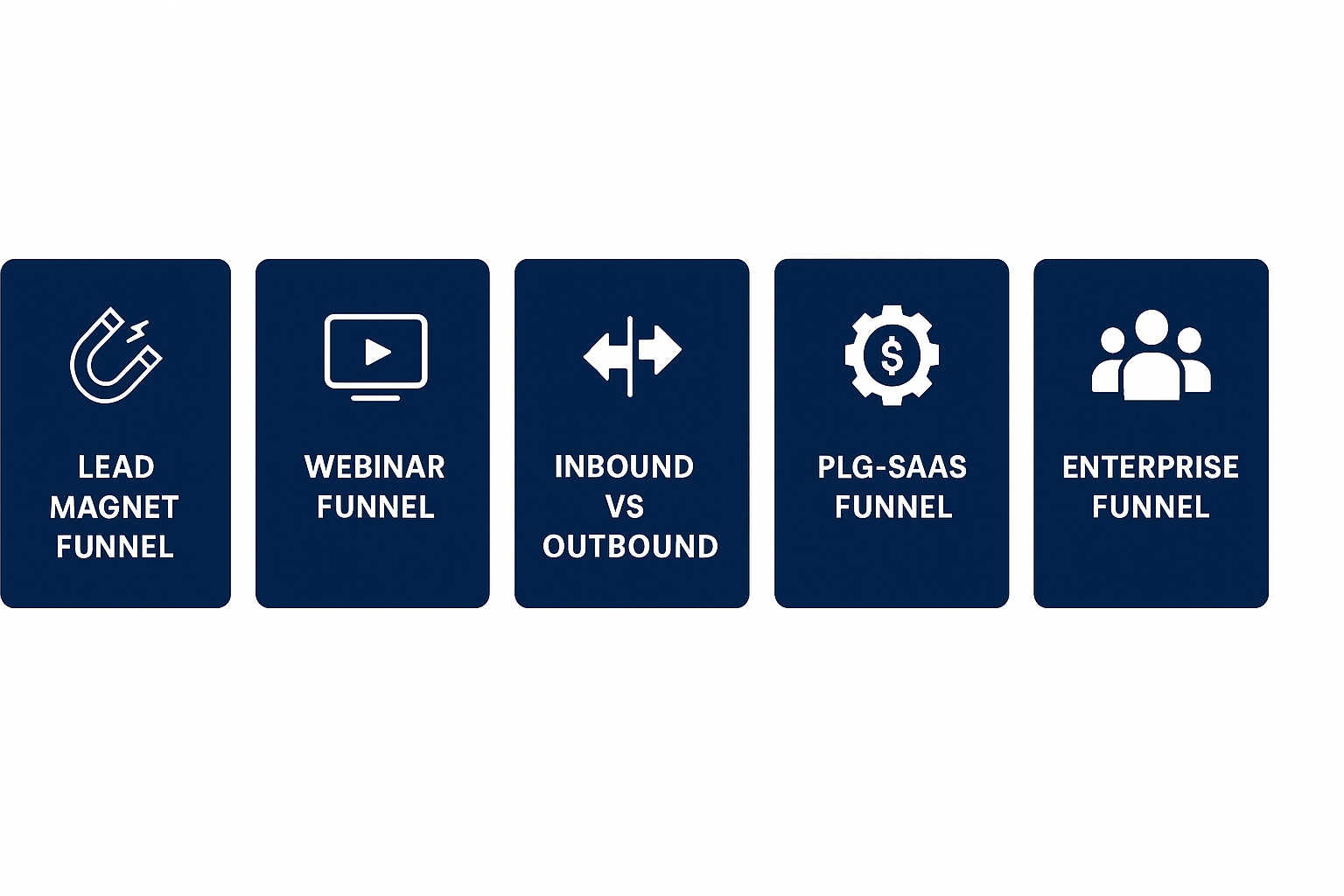
Not all sales funnels look the same. The right structure depends on your business model, product complexity, and buyer journey. Below are the most common funnel types, along with real-world examples and insights into when to use each.
1. Lead Magnet Funnel
A lead magnet funnel attracts potential buyers with a free resource in exchange for their contact information. It’s ideal for early-stage awareness and list building.
Example flow:
Step 1: Prospect downloads a free eBook, checklist, or template.
Step 2: Automated nurture sequence provides additional value and educates the lead.
Step 3: The campaign introduces a core product, demo offer, or consultation.
Best for: Coaching, digital products, online courses, or any business focused on lead nurturing before conversion.
2. Webinar Funnel
A webinar funnel converts through live or recorded sessions that teach and sell simultaneously. The event builds authority and trust while guiding attendees toward an offer.
Example flow:
Step 1: Registration page with a compelling promise.
Step 2: Webinar delivers actionable insights + introduces a product or service.
Step 3: Follow-up emails and time-sensitive offers close the sale.
Best for: SaaS, B2B services, and education-based sales models where demonstrating expertise drives conversions.
3. Inbound vs. Outbound Funnels
Inbound funnels attract leads through valuable content, SEO, and organic channels. The emphasis is on being found rather than chasing prospects.
Example: Blog → Lead magnet → Demo → Closed deal.Outbound funnels proactively reach out to target accounts via email, LinkedIn, or calls. Success depends on personalization and timing.
Example: Target list → Outreach → Discovery call → Proposal → Close.
Best for:
Inbound = content-heavy, brand-led growth strategies.
Outbound = account-based or enterprise selling with long cycles.
4. Product-Led Growth (PLG) / SaaS Funnel
A PLG funnel focuses on the product experience as the primary driver of acquisition and expansion. Instead of relying solely on sales reps, users convert through self-service trials and in-app value moments.
Example flow:
Awareness → Free trial signup → Activation milestone (first success) → Paid plan → Team expansion.
Best for: SaaS platforms, freemium tools, and products with short time-to-value.
Optimization focus: Monitor activation rate, retention, and expansion revenue instead of only top-of-funnel metrics.
5. Enterprise Multi-Threaded Funnel
Enterprise sales funnels are non-linear and involve multiple stakeholders across departments. Each contact may be at a different stage in the journey.
Example flow:
Target account → Executive outreach → Discovery with multiple departments → Business case & ROI validation → Pilot → Procurement & legal → Rollout.
Best for: High-value B2B deals, where the buying process involves finance, IT, and leadership approval.
Key success factor: Relationship mapping and deal orchestration rather than linear lead scoring.
6. Sales Lead Funnel Example
A sales lead funnel emphasizes generating, qualifying, and progressing leads efficiently:
Stages:
Prospecting and lead capture (awareness).
Lead qualification and scoring.
Product introduction or meeting booked.
Opportunity creation.
Closed deal and post-sale follow-up.
Goal: Create a predictable pipeline that continuously converts prospects into revenue.
7. Business Development Funnel Stages
Business development funnels blend sales strategy with partnership and relationship growth.
Stages:
Market research and account selection.
Outreach and engagement.
Solution alignment and proposal.
Contracting or partnership launch.
Expansion and co-marketing opportunities.
Best for: Agencies, consultancies, and enterprise vendors focused on long-term relationship value rather than one-time transactions.
8. Customer Journey Sales Funnel Mapping
A customer journey sales funnel connects internal sales stages with the buyer’s emotional and informational journey.
Buyer Stage | Sales Action | Key Content/Touchpoint |
|---|---|---|
Awareness | Marketing campaigns | Educational content, SEO blogs, social proof |
Consideration | Lead nurturing | Case studies, webinars, comparison guides |
Decision | Sales engagement | Demos, trials, pricing support |
Purchase | Closing & onboarding | Contracts, onboarding checklist |
Retention & Advocacy | Success management | Reviews, loyalty programs, referrals |
Mapping the two perspectives ensures your funnel aligns with real-world buyer behavior—making it both data-driven and customer-centric.
Tools & Technology That Supercharge the Funnel
A strong sales funnel runs on more than good strategy—it’s powered by the right tools and data systems working in sync. The modern sales stack connects marketing, sales, and customer success, allowing teams to move faster, personalize at scale, and make data-backed decisions.
1. Core Tools That Power the Funnel
CRM (Customer Relationship Management)
The CRM is the backbone of your funnel. It tracks every lead, contact, opportunity, and deal from first interaction to closed sale. Top options include HubSpot, Salesforce, and Pipedrive.
A well-configured CRM ensures that nothing slips through the cracks and that reporting reflects real buyer movement—not guesswork. For teams wanting AI built into the core, Pepper Cloud AI CRM automates lead capture and deal tracking so nothing slips through the cracks.
Marketing Automation Platforms
These tools handle email campaigns, lead nurturing, and scoring at scale. They automatically engage prospects based on behavior—like opening an email or downloading a guide.
Examples: ActiveCampaign, Marketo, Mailchimp, or HubSpot Marketing Hub.
Analytics & Dashboards
Data visualization tools such as Google Data Studio, Tableau, or Power BI help teams analyze funnel performance by stage. They display key metrics like conversion rates, time-in-stage, and revenue velocity—making it easier to spot weak points and trends.
Conversation Intelligence & Call Analytics
Platforms that record, transcribe, and analyze sales calls provide valuable insights into buyer objections, sentiment, and engagement. They help sales managers coach teams effectively and uncover patterns across winning conversations.
2. How SalesEcho Enhances Funnel Performance
Tools like SalesEcho extend beyond traditional analytics by focusing on the live selling moment—the most critical part of the funnel.
Before the Call: Reps can review automatically generated summaries of past interactions, key objections, and account context, allowing for better preparation and personalization.
During the Call: SalesEcho listens in real time and surfaces instant prompts, talk-ratio feedback, and objection-handling cues, helping reps respond naturally and keep conversations on track.
After the Call: It provides instant summaries, follow-up recommendations, and insight tagging that feed directly back into the CRM—closing the loop between activity and data.
By bridging pre-call planning, live assistance, and post-call insights, tools like SalesEcho strengthen every stage of the sales funnel—shortening cycles, improving win rates, and building consistent sales behavior across teams.
3. Best Practices for Tool Integration and Data Flow
To get the most out of your tech stack, tools must work together rather than in isolation.
Best practices include:
Integrate all data sources so lead behavior, call insights, and campaign metrics sync in real time.
Define a single source of truth—usually your CRM—to avoid conflicting reports.
Automate repetitive workflows like lead assignment, follow-ups, and reporting to save rep time.
Establish feedback loops between marketing, sales, and customer success using shared dashboards.
Ensure data hygiene by regularly cleaning duplicates, updating lifecycle stages, and archiving old records.
A streamlined tool ecosystem ensures that your funnel is not just filled—but intelligently managed, measured, and continuously improved.
Sales Funnel Tips for Beginners & Advanced Teams
Whether you’re just getting started with funnel building or managing a complex multi-stage sales operation, optimization never truly ends. The best-performing teams refine their funnel continuously—improving structure, automation, and insight with each cycle.
Below is a tiered breakdown of tips and strategies for every level of experience.
1. Sales Funnels for Beginners: The Essentials
If you’re new to building a sales funnel, focus on structure first. Your early goal is to create clarity, consistency, and visibility.
Beginner Checklist:
Define your funnel stages clearly (Awareness → Consideration → Decision → Purchase).
Set stage criteria so you know exactly when a lead qualifies to move forward.
Build a simple lead capture process—for example, a form or landing page connected to your CRM.
Map 1–2 content assets per stage (e.g., a blog for TOFU, a case study for MOFU, a demo for BOFU).
Review your funnel weekly to track drop-offs and make one improvement at a time.
Keep it simple. A basic, transparent funnel with reliable data beats a complicated one that no one updates.
2. Intermediate Level: Segmentation, Nurturing & Account Focus
Once the basics are in place, the next step is personalization and alignment. Intermediate teams focus on nurturing leads more effectively and treating each segment differently.
Key Practices:
Funnel segmentation: Divide leads by persona, industry, or deal size to tailor messaging.
Multi-channel nurturing: Use email, social media, retargeting ads, and webinars to maintain engagement across touchpoints.
Account-based funnel management: For B2B sales, focus on accounts rather than individual leads. Coordinate outreach among multiple stakeholders.
Lifecycle scoring: Assign numeric values to actions (downloads, clicks, demos booked) to quantify buyer intent.
Team alignment: Ensure marketing, sales, and customer success share visibility into the same CRM dashboards.
At this level, your goal is efficiency—moving qualified prospects faster through the funnel by using data-driven targeting.
3. Advanced Level: AI-Assisted & Predictive Funnel Optimization
Mature teams go beyond tracking performance—they use AI and predictive analytics to anticipate behavior, automate decisions, and continuously refine outcomes.
Advanced Strategies:
AI-assisted insights: Use conversation intelligence and analytics tools to identify conversion patterns, common objections, and successful talk ratios.
Predictive scoring: Train models on historical data to forecast which leads are most likely to close and when.
Automated routing: Dynamically assign leads based on intent, region, or deal potential to minimize response time.
Revenue funnel optimization: Combine marketing, sales, and post-sale data into a unified “revenue funnel” view to monitor retention, upsells, and recurring revenue health.
Continuous testing: Apply A/B testing across email sequences, outreach scripts, and content touchpoints to lift conversion rates.
At this stage, success means moving from reactive management to proactive optimization—where data guides every decision, and automation removes friction from both buyer and seller experiences.
Real-World Examples & Case Studies
Understanding how different industries structure their funnels provides valuable perspective. While the fundamentals remain the same—awareness, consideration, and decision—the execution and emphasis shift depending on deal size, sales cycle length, and buyer behavior.
Below are three examples of how sales funnels work in practice across SaaS, service-based, and enterprise businesses.
1. SaaS Digital Sales Funnel Stages
SaaS (Software-as-a-Service) companies rely on short, data-driven cycles where the product itself often acts as the salesperson. The funnel focuses on user activation, product experience, and retention rather than one-time sales.
Example Structure:
Awareness: Blog posts, SEO, and educational videos attract problem-aware users.
Consideration: Free tools, comparison pages, and customer success stories highlight value.
Decision: Free trials, demos, and in-app onboarding showcase real usage benefits.
Purchase: Simple, self-serve sign-up or assisted purchase.
Retention & Expansion: Usage monitoring, feature prompts, and upgrade offers maintain momentum.
Key Insight: In SaaS, speed to value is critical. The faster users reach their first “aha moment,” the higher the likelihood they convert and stay active.
2. Service Business Funnel
Service-based businesses—such as agencies, consultants, or professional services—depend heavily on trust and reputation. Their funnels emphasize authority, proof, and relationship-building.
Example Structure:
Awareness: Blog content, referrals, and social proof (testimonials or case studies).
Consideration: Free consultations, webinars, or tailored service pages explain solutions.
Decision: Proposal submission and value-based pricing discussions.
Purchase: Contract signing and kickoff.
Post-Sale: Ongoing communication, results reporting, and referral requests.
Key Insight: For service providers, a consistent post-sale process—check-ins, reporting, and testimonials—fuels both retention and new client acquisition.
3. Enterprise Funnel with a Long Sales Cycle
Enterprise deals involve multiple decision-makers, larger budgets, and longer timelines. The funnel is multi-threaded, with parallel conversations happening across technical, financial, and executive teams.
Example Structure:
Awareness: Targeted outreach, thought leadership, and account-based marketing (ABM).
Consideration: Workshops, ROI models, and pilot proposals tailored to each stakeholder group.
Decision: Procurement, security review, and legal negotiation.
Purchase: Final approval and implementation planning.
Expansion: Dedicated customer success managers identify upsell and cross-sell opportunities.
Key Insight: The enterprise funnel succeeds through orchestration—coordinating messaging and value delivery across multiple touchpoints over time.
Common Mistakes & How to Avoid Them
Even the most promising sales funnels can underperform if they’re poorly structured or inconsistently maintained. Many businesses focus on driving more leads instead of improving how those leads move through the funnel. Below are four of the most common mistakes—and how to prevent them.
1. No Stage Definitions or Inconsistent Qualification
The problem:
Without clear definitions for each stage, teams operate on assumptions. One rep might mark a contact as an “opportunity” after a demo, while another waits for a verbal commitment. This inconsistency creates unreliable data, inflated forecasts, and wasted follow-up efforts.
How to avoid it:
Define each funnel stage and its exit criteria—what qualifies a lead to advance.
Use structured frameworks like BANT, MEDDIC, or SPICED to ensure objective qualification.
Align marketing and sales on what constitutes an MQL, SQL, and Opportunity.
Clear criteria make your funnel measurable and prevent confusion about deal status or quality.
2. Ignoring the Post-Purchase Loop
The problem:
Many teams treat “closed won” as the finish line. In reality, that’s where the next funnel begins—onboarding, retention, upsell, and advocacy. Ignoring this loop limits lifetime value and slows organic growth.
How to avoid it:
Integrate customer success metrics (renewal rates, satisfaction scores, expansion revenue) into your funnel tracking.
Create post-purchase playbooks that include onboarding checklists, training sessions, and review requests.
Encourage feedback and referral programs to keep satisfied customers engaged.
A funnel that extends beyond the sale turns one-time buyers into long-term advocates.
3. Relying Purely on Human Reps Instead of Automation & AI
The problem:
Sales teams still handle too many manual tasks—logging calls, sending follow-ups, qualifying leads—that could easily be automated. This slows response time and leads to inconsistent buyer experiences.
How to avoid it:
Use automation tools for lead scoring, email sequences, and task reminders.
Leverage AI insights to identify buying signals, detect stalled deals, and recommend next actions.
Empower reps with real-time data so they can focus on conversations, not admin work.
Technology doesn’t replace the human touch—it amplifies it by eliminating busywork and highlighting what matters most.
4. Not Cleaning or Analyzing the Funnel Regularly
The problem:
Funnels decay quickly when data goes unchecked. Duplicates, outdated leads, and untracked opportunities distort your performance metrics and lead to poor forecasting.
How to avoid it:
Conduct a monthly funnel audit to check for data hygiene issues.
Review stage conversion rates and average time-in-stage for anomalies.
Remove or reclassify inactive leads to maintain accuracy.
Automate reports that show trends and leaks so your team can act early.
A clean funnel is a trustworthy funnel—one that tells you where to focus effort and where to optimize next.
Frequently Asked Questions
Below are the most common questions about sales funnels—each answered clearly and concisely for both readers and search engines.
1. What is a sales funnel?
A sales funnel is a visual model showing how potential customers move from discovering your business to becoming paying clients. It helps teams measure conversion rates, identify drop-offs, and improve predictability across marketing and sales.
2. What are the 5 stages of the sales funnel?
The five classic stages are:
Awareness – Prospects first learn about your brand.
Consideration – They research and compare options.
Decision – They choose a provider or product.
Purchase – They complete the transaction.
Loyalty / Advocacy – They renew, recommend, or refer others.
3. What are the 4 stages of the sales funnel?
A simplified version uses four stages:
Awareness – Grabbing attention.
Interest – Building curiosity.
Decision – Presenting solutions and resolving objections.
Action – Finalizing the purchase.
This model aligns with the AIDA framework: Awareness, Interest, Desire, Action.
4. How do I create a sales funnel?
To create a sales funnel:
Define clear stages and qualification rules.
Map relevant content or offers to each stage.
Use a CRM and automation tools to track and nurture leads.
Review conversion data to locate and fix weak points.
Keep refining based on real buyer behavior.
5. What are the best sales funnel tools?
The best tools depend on your team size and complexity, but most strong funnels use:
CRM systems: HubSpot, Salesforce, Pipedrive.
Marketing automation: ActiveCampaign, Marketo, Mailchimp.
Analytics & dashboards: Google Data Studio, Tableau, Power BI.
Conversation intelligence: SalesEcho, Gong, or Otter—tools that analyze calls, surface insights, and help teams optimize performance across the funnel.
Related: Best AI Sales Call Assistants
6. What are the 6 stages of the sales funnel?
An extended model adds more granularity:
Awareness
Interest
Consideration
Intent
Purchase
Retention / Advocacy
This structure helps teams manage both acquisition and post-sale growth.
7. What is a sales funnel diagram?
A sales funnel diagram is a visual representation—usually an inverted triangle—showing how leads flow through each stage and where drop-offs occur. It’s often used in reports and dashboards to illustrate performance trends.
8. What are the three parts of a sales funnel?
The three main parts are:
Top of the Funnel (TOFU): Awareness and lead generation.
Middle of the Funnel (MOFU): Nurturing and qualification.
Bottom of the Funnel (BOFU): Closing and conversion.
Final Thought
A sales funnel isn’t a one-time setup; it’s a living framework that needs structure, automation, and maintenance. Define your stages, close the post-purchase loop, empower your team with technology, and keep your data clean.
Do that consistently, and your funnel becomes not just a process—but a growth engine that compounds over time.