
What is B2B Lead Generation?
 Rishabh Jain
What is B2B Lead Generation?
B2B lead generation — short for business-to-business lead generation — is the process businesses use to attract and convert other companies into potential clients through strategic marketing and sales efforts.
“B2B lead generation is the process businesses use to attract and convert other businesses into potential clients through marketing and sales strategies.”
In simpler terms, it’s how one company finds and connects with other companies that might benefit from its product or service. Unlike B2C, where you sell directly to individual consumers, B2B focuses on building relationships with decision makers, teams, and organizations.
Quick Example
Imagine a SaaS startup that provides cybersecurity software.
They create LinkedIn thought-leadership posts, run targeted campaigns, and publish expert guides. When enterprise IT managers engage with this content, they become qualified B2B leads, ready to be nurtured into paying customers.
This is a classic example of B2B lead prospecting, identifying and engaging high-intent business buyers.
Why It Matters
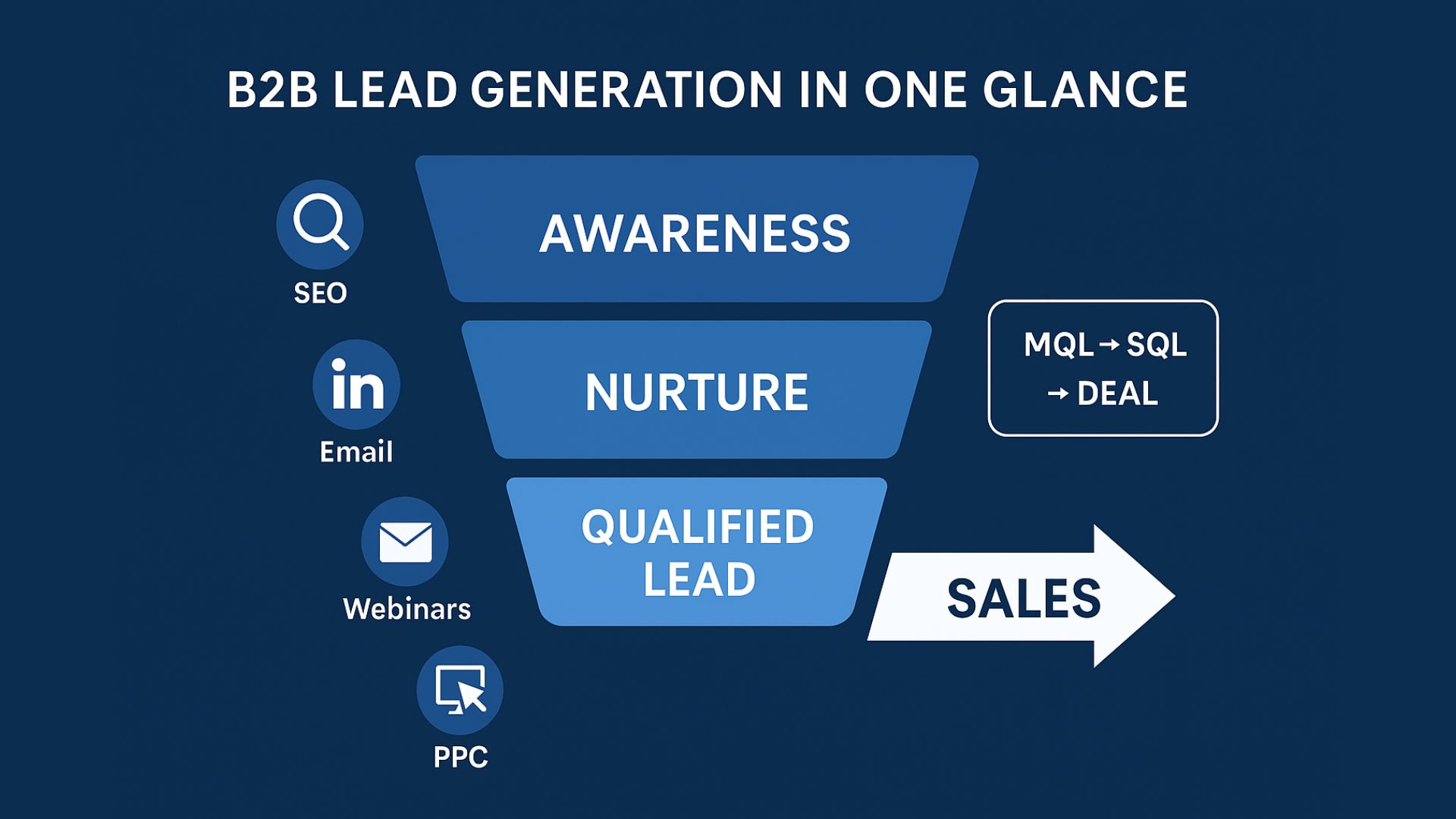
Understanding what lead generation in B2B means is the foundation of any successful marketing or sales strategy. It’s not just about collecting email addresses, it’s about attracting the right businesses, qualifying them effectively, and guiding them through a structured funnel toward conversion.
Why B2B Lead Generation Matters in 2026
In today’s hyper-competitive landscape, B2B corporate lead generation isn’t just a marketing activity, it’s the engine that fuels predictable, scalable growth. With buying cycles getting longer and decision making involving multiple stakeholders, companies that master B2B lead generation consistently build stronger pipelines and outperform their competitors.
Lead Generation = Predictable Growth
The most successful B2B companies treat lead generation like a system, not a guessing game. Instead of relying on random referrals or one-off campaigns, they create repeatable B2B sales lead generation engines, combining SEO, LinkedIn, content marketing, outbound, and real-time tools to consistently fill their funnel with high-quality prospects.
Did you know?
61% of B2B marketers say improving lead quality is their top challenge (Source).
That’s why refining your lead generation process matters more than ever.
Shifting Buyer Behavior in the AI Era
B2B buyers in 2026 don’t behave like they did even two years ago. Thanks to AI powered search, “dark social” conversations (e.g., private Slack groups, WhatsApp, niche communities), and micro moment decision making, the buyer’s journey is increasingly fragmented.
Decision-makers now research extensively before ever talking to sales
They rely on AI summaries and community recommendations instead of cold outreach
They expect personalized experiences at every stage of the funnel
This shift means businesses must adapt their lead generation tactics to meet buyers where they are, not where they were.
The Rising Importance of First Party Data & Personalization
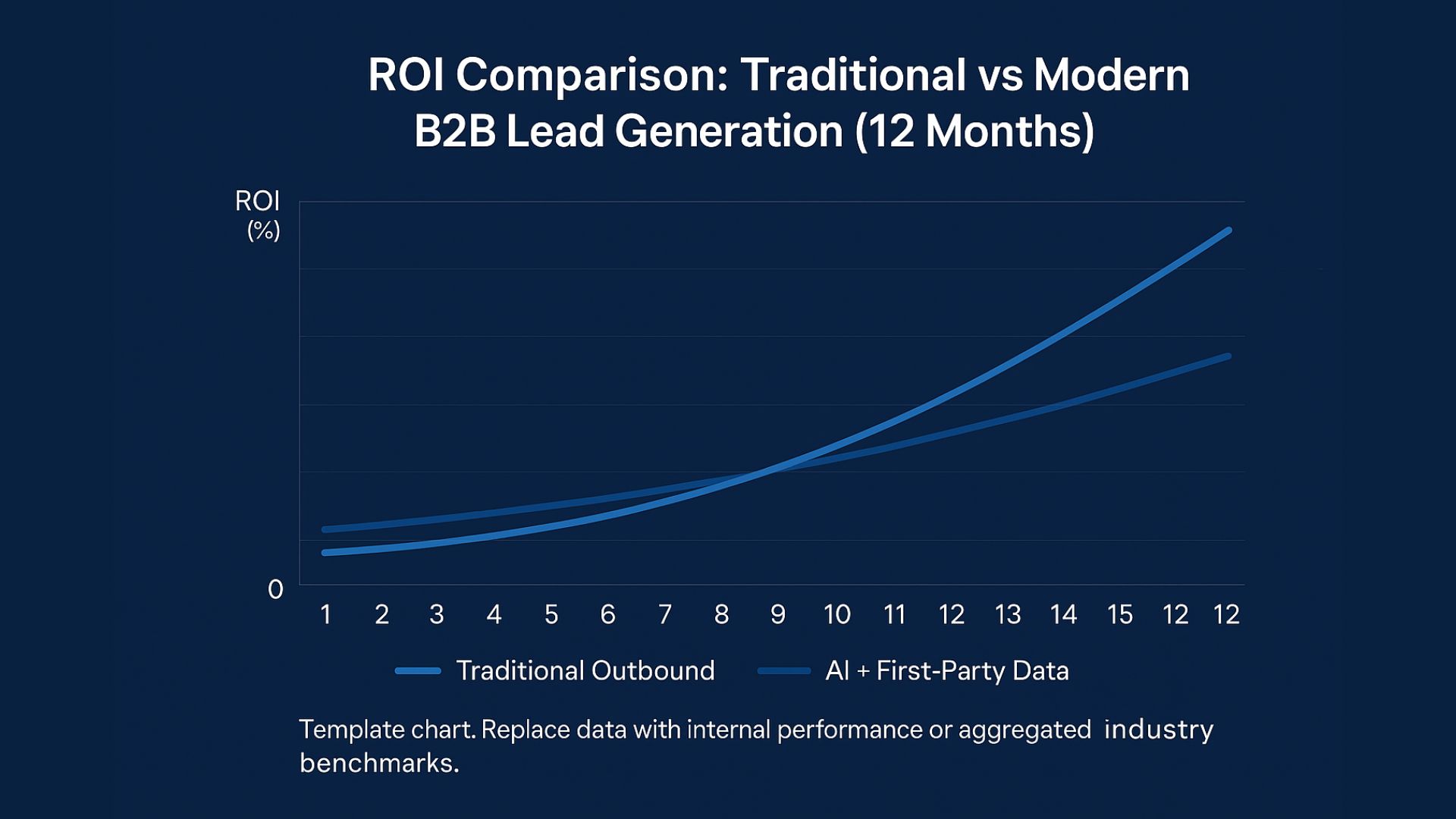
With third-party cookies fading and privacy regulations tightening, companies can no longer rely solely on paid ads and scraped lists. First party data, the insights you collect directly from your audience, is becoming a strategic advantage.
When paired with intelligent personalization, this data helps businesses:
Target the right companies with precision
Create hyper-relevant content and offers
Shorten sales cycles and increase close rates
-> That’s why modern B2B lead generation strategies focus on building owned data assets, nurturing them with personalized campaigns, and using AI tools to act in real time.
The B2B Lead Generation Process Explained
A strong B2B lead generation process gives structure to how prospects move from being unknown visitors to qualified opportunities. Whether you’re a SaaS company, agency, or enterprise, following a clear process helps you scale efficiently, shorten sales cycles, and increase ROI.
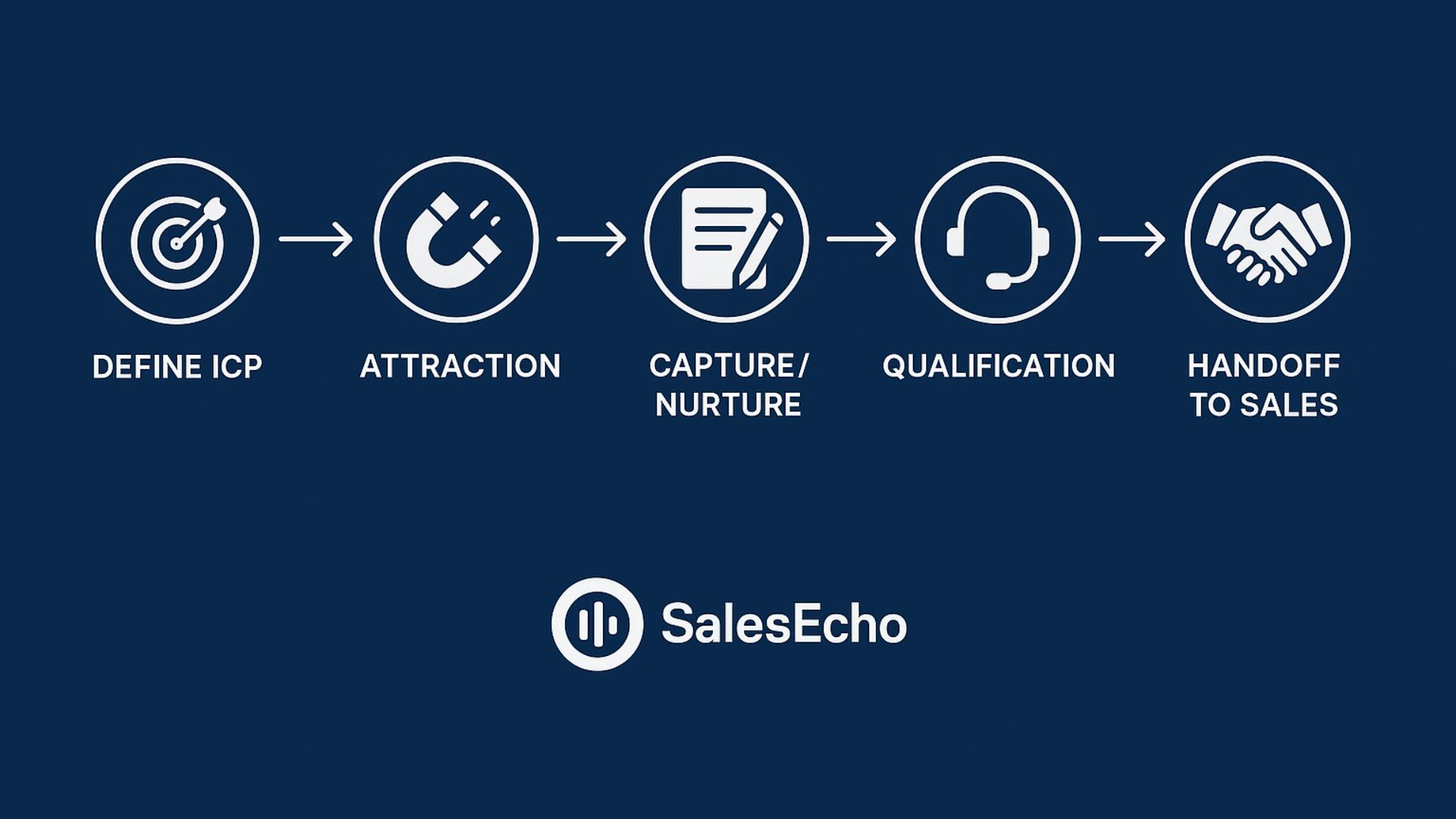
Here’s a breakdown of the five key stages every effective lead generation strategy in B2B should include:
1. Defining Your ICP & Buyer Personas
Before generating leads, you need to know who you’re targeting. This means creating a clear Ideal Customer Profile (ICP) and detailed buyer personas.
Firmographics: company size, revenue, location, industry
Technographics: tools and platforms they use
Pain points: the core problems your solution solves
Decision-makers: identifying the right people to reach (e.g., VPs, IT leads, founders)
By understanding your B2B audience targeting deeply, your marketing and sales teams can focus efforts on high-value accounts instead of wasting time on mismatched leads.
2. Attracting Prospects Through B2B Marketing Channels
Once your ICP is clear, it’s time to attract the right prospects. Modern B2B online lead generation relies on a mix of inbound and outbound strategies to meet buyers where they are:
SEO – Long-tail keywords, authoritative content, and optimized landing pages
LinkedIn – Thought leadership, targeted ads, and social selling
Cold Email – Personalized outreach sequences to warm domains
Webinars & Events – Building trust through value-driven education
PPC Campaigns – High-intent targeting through Google & LinkedIn Ads
These tactics power b2b website lead generation and b2b digital lead generation, bringing consistent traffic and interest from qualified buyers.
3. Capturing & Nurturing Leads
Attraction isn’t enough — you need to capture contact information and nurture relationships over time.
Use lead magnets like guides, calculators, or templates to collect emails
Gate premium assets to qualify interest
Set up automated email sequences to nurture prospects with personalized content
This is where strong b2b lead management systems shine. Well-structured b2b lead generation campaigns keep prospects engaged and steadily warm them toward conversion.
Related: How to improve the sales call conversion
4. Qualifying & Scoring Leads
Not every lead is ready for sales. That’s why b2b lead qualification is essential. Using frameworks like MQL vs SQL, BANT (Budget, Authority, Need, Timeline), or CHAMP, you can score leads based on fit and readiness.
Pro Tip: Pair your scoring model with SalesEcho’s real-time coaching to help reps ask sharper discovery questions, qualify leads live, and seamlessly move them from MQL to SQL.
This step ensures marketing focuses on volume, while sales focuses on quality, a crucial lead generation tactic in B2B.
5. Handing Off to Sales & Closing
The final stage is aligning marketing and sales for a smooth handoff. This involves:
Passing qualified leads with all relevant context (interactions, score, notes)
Enabling sales teams with real-time insights
Closing deals through structured outreach, demos, and personalized follow-ups
When this handoff is done well, b2b marketing sales leads convert more predictably, leading to a healthier pipeline of business-to-business sales leads.
Top B2B Lead Generation Strategies That Work
Modern B2B lead generation strategy blends timeless marketing tactics with innovative AI-powered approaches. Whether you’re targeting enterprise buyers or scaling a B2B SaaS pipeline, the key is to combine multiple tactics that work together to attract, engage, qualify, and convert.
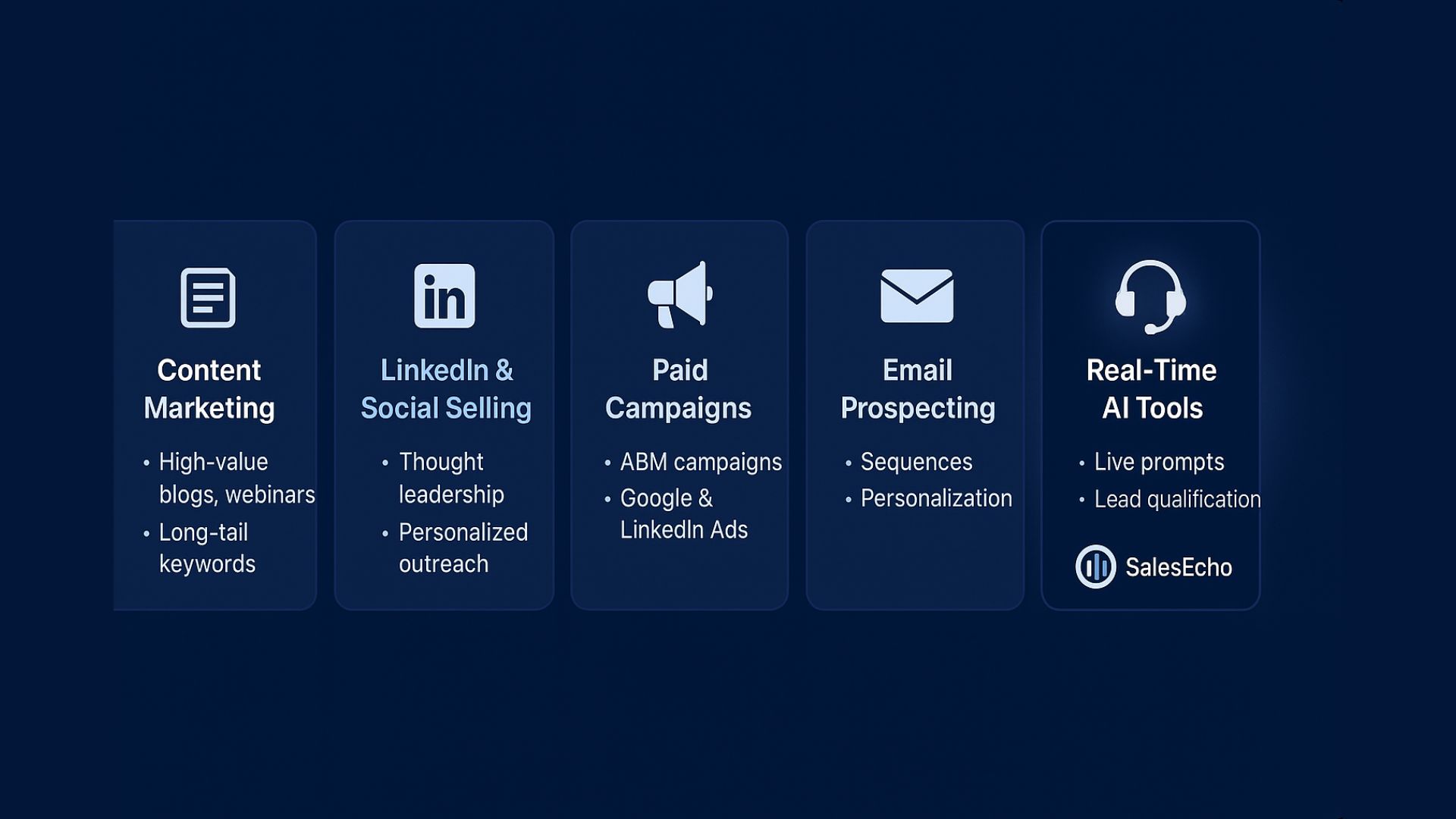
Below are the proven B2B lead generation tactics that leading companies rely on in 2026:
1. Content Marketing & SEO
Content is still the foundation of strong b2b saas lead generation. Buyers now do most of their research before speaking to sales — meaning your content has to show up early in their journey.
High-value content: Publish in-depth blog posts, whitepapers, industry reports, and toolkits that solve real problems.
Webinars & workshops: Position your team as experts while capturing high-intent leads.
Long-tail keyword targeting: Focus on search queries like “b2b lead generation guide for SaaS companies” rather than generic phrases — this helps win zero-click and AI Overview positions.
Pro Tip: Internal linking between content clusters (e.g., strategy guides → case studies → landing pages) compounds organic visibility and lead flow.
2. LinkedIn & Social Selling
LinkedIn remains the go-to platform for B2B lead generation strategy. Decision-makers are active daily, making it ideal for personalized, trust-driven outreach.
Use Sales Navigator to target by firmographics and buying signals
Publish thought-leadership posts, polls, and carousels to build visibility
Send personalized outreach — focus on value, not templates
Engage in comment sections and groups to spark warm conversations
This approach builds relationships before the pitch, making later conversions smoother.
3. Paid Campaigns & Retargeting
Paid media accelerates reach and allows precise targeting. Effective B2B lead generation campaigns use:
ABM (Account-Based Marketing) ads to reach key decision-makers in specific companies
Retargeting campaigns to nurture visitors who didn’t convert on their first touch
LinkedIn & Google Ads with tailored messaging for each funnel stage
For example, a b2b lead generation campaign might use LinkedIn video ads for awareness, followed by retargeted Google search ads to capture high-intent leads.
4. Email Outreach & Cold Prospecting
Despite the rise of new channels, cold email remains one of the highest ROI B2B lead generation tactics — when done right.
Warm up domains to protect deliverability
Use structured sequences (3–5 emails) with personalization at scale
Segment your lists by ICP and buyer stage for more relevance
Add human touches: referencing LinkedIn posts, recent funding, or shared interests
This approach is particularly powerful for lead generation for B2B companies with defined outbound teams and tight targeting.
5. Real-Time Tools to Supercharge B2B Lead Generation
This is where modern strategies break away from the old playbook. AI-powered, real-time tools are transforming how teams qualify, coach, and close leads.
SalesEcho is a prime example. It’s a real-time AI sales call assistant that:
Listens to live calls
Surfaces prompts for reps in real time
Helps qualify leads during conversations
Boosts conversion rates by up to 30%
Instead of waiting for post-call reviews, teams get instant coaching, objection handling cues, and qualification nudges — making lead gen more intelligent and efficient.
“With tools like SalesEcho, your team can turn conversations into conversions — instantly.”
This kind of b2b sales lead generation and b2b lead management is where the future is headed, combining human skill with machine intelligence.
B2B Lead Generation Techniques for Modern Businesses
As buyer behavior evolves, so must the methods used to generate leads. Modern B2B lead generation techniques focus on leveraging data, AI, and strategic partnerships to reach the right prospects at the right time in smarter, more personalized ways.
Below are the most effective techniques forward-thinking companies are using in 2026 to strengthen their B2B corporate lead generation.
1. AI Lead Scoring & Enrichment Tools
Manual lead qualification is no longer scalable. AI-powered tools now analyze firmographics, technographics, intent data, and engagement signals to score leads in real time.
Automatically identify high-fit, high-intent prospects
Enrich data with job titles, company size, tools used, and buying triggers
Prioritize the leads most likely to convert
This ensures marketing and sales teams focus on the right leads, not just more leads.
2. Event-Based and Referral Marketing
Even in a digital-first world, events remain powerful for lead generation. Webinars, virtual summits, and niche community events are excellent for building trust and capturing warm leads.
Host webinars with clear value propositions and follow up strategically
Leverage referral programs that incentivize existing customers or partners to bring in qualified leads
Event and referral strategies consistently produce some of the highest-converting B2B lead generation results.
3. Partnerships, Co-Marketing & Intent-Based Outreach
Partnering with complementary companies allows you to tap into pre-warmed audiences while sharing marketing efforts.
Run joint webinars or co-branded content campaigns
Exchange guest posts or newsletters to cross-pollinate audiences
Layer intent data (such as tool usage and buying signals) to reach prospects at the right moment
This approach amplifies reach and credibility while keeping acquisition costs efficient.
4. Social Proof & Personalization Tactics
In B2B, trust is critical. Modern lead generation relies on social proof and personalization to build credibility and relevance.
Highlight case studies, client logos, testimonials, and performance metrics
Personalize outreach and landing pages based on industry, role, or behavior
Use dynamic content to tailor messaging at scale
This combination builds confidence and accelerates buying decisions.
Combine LinkedIn retargeting with SEO content for double conversion impact. Retargeting high-intent organic visitors with LinkedIn ads keeps your brand top of mind and turns passive interest into active pipeline.
Real-World B2B Lead Generation Examples
Theory is useful, but nothing beats seeing how real companies apply B2B lead generation strategies in practice. The following examples illustrate how different industries use various tactics to drive measurable growth. Each scenario shows how strategic execution can dramatically improve lead volume, quality, and conversion rates.
SaaS Startup + SEO + LinkedIn
A B2B SaaS startup focused on workflow automation used a dual SEO + LinkedIn strategy to scale its lead funnel efficiently.
Published a series of long-form SEO guides targeting niche long-tail keywords around automation challenges.
Distributed the content through targeted LinkedIn campaigns using sponsored posts and thought-leadership posts by the founder.
Retargeted website visitors with LinkedIn lead-gen forms to capture warm prospects.
Results:
5x increase in organic traffic in six months
3.4x lift in LinkedIn engagement
2.8x increase in qualified leads entering the pipeline
This example highlights how a strategic inbound engine, supported by social amplification, can generate sustainable b2b lead generation results for SaaS companies.
Manufacturing Company + Events + Email
A mid-sized manufacturing firm adopted a hybrid traditional + digital approach to generate new distributor and supplier leads.
Hosted quarterly industry events and product demonstrations.
Collected attendee data and segmented contacts based on buying roles.
Followed up with targeted email sequences featuring spec sheets, case studies, and booking links.
Results:
37% increase in MQL-to-SQL conversion rate
45% higher attendance rates for subsequent events due to improved email targeting
A predictable pipeline of new B2B accounts each quarter
This approach shows how blending events with smart email follow-up can modernize b2b lead generation campaigns even in traditional industries.
B2B eCommerce + PPC Retargeting
A B2B eCommerce platform selling industrial supplies focused on high-intent PPC retargeting to boost ROI.
Ran Google Search campaigns targeting product-specific keywords.
Retargeted abandoned cart visitors with display ads and LinkedIn sponsored posts.
Used dynamic product ads to bring prospects back to the exact product pages they viewed.
Results:
51% improvement in ad conversion rates
29% reduction in cost per lead
2.3x ROI increase over three months
This example demonstrates how retargeting can become one of the most effective b2b lead generation techniques for eCommerce-style funnels.
SalesEcho Case Study
A B2B SaaS sales team integrated SalesEcho into their outbound and inbound call workflows to improve lead qualification and conversion in real time.
What They Did:
Deployed SalesEcho as a live call assistant for their reps.
Used real-time prompts to handle objections, improve discovery questions, and identify strong buying signals.
Integrated qualification criteria into the live coaching layer to reduce post-call friction between marketing and sales.
Results (3 Months):
Metric | Before SalesEcho | After SalesEcho |
|---|---|---|
Qualified Leads per Month | 250 | 320 |
Conversion Rate (SQL to Opp) | 18% | 23% |
Average Response Time | 2.4 hrs | 35 mins |
Overall Pipeline Lift | — | 28% increase |
This b2b saas lead generation example shows how real-time AI tools can directly impact performance, shorten cycles, and improve conversion rates across the funnel.
Common Mistakes in B2B Lead Generation (and How to Avoid Them)
Mistake | Fix |
|---|---|
Focusing on volume, not quality | Prioritize high-intent leads |
No clear ICP or lead scoring | Define and score your ICP |
Poor marketing → sales handoff | Align teams and processes |
Over-reliance on one channel | Diversify your lead engines |
Ignoring real-time buyer signals | Monitor engagement cues and act quickly |
The Future of B2B Lead Generation
B2B lead generation is entering a new era defined by AI, data, and personalization. Over the next decade, the way businesses attract and convert leads will shift from traditional outbound tactics to predictive, intent driven, and conversation based strategies. Companies that adapt early will gain a lasting competitive edge.
Rise of AI Search and GEO Strategies
AI driven search tools (like ChatGPT, Perplexity, Gemini, and SearchGPT) are reshaping how buyers discover solutions. Instead of typing keywords into search engines, decision-makers are asking questions in conversational interfaces and receiving summarized answers.
This shift means companies need Generative Engine Optimization (GEO) strategies:
Structuring content to be easily interpreted by AI models
Providing direct, well-formatted answers to rank in AI overviews
Building topical authority through high-quality, structured resources
Predictive Analytics, Hyper-Personalization, and Conversational Intelligence
Future B2B lead generation will rely on data driven precision. Predictive analytics will help companies forecast buyer intent before leads even fill out a form. Combined with hyper-personalized content and real time conversational intelligence, businesses will be able to:
Identify high-intent accounts earlier
Deliver custom experiences at scale
Adapt messaging dynamically during calls or live chats
This moves lead generation from reactive to proactive.
Privacy Shifts and the Rise of First-Party Data
With third party cookies being phased out and data privacy regulations tightening, B2B companies will need to build first-party data ecosystems. This means:
Capturing and nurturing leads through owned channels (websites, webinars, gated content)
Using clean, consent-based data for targeting and segmentation
Investing in secure data infrastructure to comply with privacy standards
Those who rely too heavily on third-party data will struggle to compete as privacy landscapes evolve.
Voice Search and New Outbound Patterns
Voice based interfaces and AI assistants are changing how people search, consume content, and make decisions. B2B brands will need to:
Optimize content for conversational, natural language queries
Prepare outbound strategies for voice-first environments
Experiment with audio formats, voice notes, and real-time assistant integrations
Outbound will become less about cold outreach and more about contextual engagement through new mediums.
FAQs
What does B2B lead generation mean?
B2B lead generation means finding and attracting other businesses that could become your customers. Instead of marketing to individual consumers, you focus on decision-makers and teams within companies.
Example: A software company using LinkedIn Ads to get demo requests from IT directors at mid-sized firms.
How to generate leads in B2B?
You generate B2B leads by combining inbound and outbound tactics that bring qualified prospects into your pipeline.
Inbound: SEO, content marketing, LinkedIn, webinars, lead magnets
Outbound: Cold email, targeted outreach, events, paid campaigns
The most effective strategies align both, supported by data and AI tools for qualification.
What does B2B stand for?
B2B stands for Business-to-Business — when one business sells products or services to another business (rather than directly to consumers).
What are the four types of B2B?
The four common types are:
Producers: Businesses that manufacture goods or services
Resellers: Distributors and wholesalers
Governments: Public sector buyers and agencies
Institutions: Nonprofits, schools, hospitals, etc.
These categories help marketers tailor their strategies to different buyer behaviors.
What are the 7 P's of B2B?
The 7 P’s are the marketing mix adapted for B2B:
Product
Price
Place
Promotion
People
Process
Physical Evidence
In B2B, “People” and “Process” play a larger role because purchases are often complex and relationship-driven.
Which is a B2B example?
A logistics software company selling route-optimization tools to eCommerce businesses is a classic B2B example.
Another example: A cybersecurity firm providing solutions to banks and financial institutions.
Who are B2B clients?
B2B clients are companies, organizations, or institutions that buy your product or service to solve business problems, streamline operations, or grow revenue. They usually involve multiple stakeholders in the buying process.
Is Netflix a B2B or B2C?
Primarily, Netflix is B2C — it sells subscriptions directly to consumers. However, Netflix also has B2B aspects, like licensing content to airlines and hotels, but its core model is consumer-focused.
Is WhatsApp B2B or B2C?
WhatsApp started as a B2C messaging app but now also has a B2B component through WhatsApp Business, which allows companies to communicate with customers via automated messages, catalogs, and support.
Is Amazon a B2B company?
Amazon is both B2C and B2B.
B2C: The main retail marketplace.
B2B: Amazon Business, which sells to organizations, schools, and companies with bulk pricing and procurement tools.
Is Coca-Cola a B2C or B2B?
Coca-Cola operates as both, but its primary model is B2B. It sells beverages to distributors, retailers, restaurants, and vendors, who then sell to consumers. The company focuses heavily on building partnerships with businesses in the supply chain.
Key Takeaways & Next Steps
B2B lead generation has evolved far beyond cold calls and generic ads. Modern strategies combine data, personalization, content, and AI tools to build smarter, more predictable pipelines.
By clearly defining your ICP, using multiple marketing channels, qualifying leads effectively, and embracing real-time technologies, your business can consistently attract and convert the right prospects.
As privacy shifts, AI search grows, and buyer journeys become more complex, the companies that win will be those that adapt early and optimize across every stage of the funnel.
If you're ready to take your B2B lead generation to the next level, consider integrating real-time solutions like SalesEcho to boost conversion rates and streamline qualification.