
B2B Demand Generation Strategy & Fundamentals (2026): The Complete Guide for Modern Marketers
 Rishabh Jain
TL;DR
B2B demand generation is the engine that builds awareness, interest, and buying intent before your audience is ready to purchase. Unlike lead generation, which chases gated conversions. demand gen focuses on education, trust, and value, turning cold audiences into warm opportunities over time.
Modern B2B demand generation marketing combines ungated content, multi-channel outreach, and AI-driven insights to capture, convert, and expand qualified demand across every stage of the funnel, fueling consistent, compounding revenue growth.
What Is B2B Demand Generation?
Definition of Demand Generation (DG)
B2B demand generation is a long-term marketing strategy focused on creating awareness, interest, and buying intent among potential customers who aren’t yet ready to purchase.
It combines education, brand positioning, and relationship-building to nurture prospects across the entire buying journey, not just at the conversion point.
Demand Generation Meaning & Purpose
The goal of demand generation is simple: generate interest and trust before the sale happens.
Instead of pushing forms and downloads, it delivers consistent value through thought leadership, data-driven insights, and memorable brand experiences.
Difference Between Demand Creation and Lead Capture
Demand Creation: Focuses on building awareness and educating your total addressable market (TAM).
Lead Capture: Happens when that interest turns into measurable intent, e.g., demo requests or trial sign-ups.
A healthy B2B pipeline needs both, but creation comes first.
Why It Matters in B2B Marketing
B2B buyers take longer to decide, often involving multiple stakeholders and months-long research. Demand generation ensures your brand is part of that early consideration set.
It also closes the gap between marketing and sales, improving lead quality and conversion efficiency.
Benefits:
Builds awareness for long, complex buying cycles
Strengthens brand-to-demand alignment
Keeps your brand top-of-mind when budgets open
Demand Gen vs. Lead Gen: Key Differences
Aspect | Demand Generation | Lead Generation |
|---|---|---|
Goal | Educate & nurture future buyers | Capture ready-to-buy leads |
Content Type | Ungated, educational, awareness-driven | Gated assets, demos, trials |
KPIs | Engagement, reach, pipeline influence | Form fills, MQLs, conversion rate |
Mindset | Long-term trust | Short-term conversion |
Approach | Brand storytelling & education | Offers, CTAs, and lead forms |
Example: A split-funnel analysis by leading SaaS firms showed that optimizing for awareness and education led to 40% higher qualified pipeline growth versus traditional lead-gen-only models.
The Demand Generation Funnel (Stages + Strategy)
In B2B marketing, the demand generation funnel is more than a sequence of conversion steps — it’s a full-cycle system that creates awareness, nurtures interest, captures intent, and converts qualified demand into revenue.
Each stage plays a unique role in moving prospects from “never heard of you” to “ready to buy.”
Stage 1 – Create Demand (TOFU)
The top of the funnel is where awareness is built — not through gated offers, but through education and thought leadership.
Your goal: Make your target audience realize a problem exists and that your solution space matters.
Tactics:
Publish ungated educational content like podcasts, YouTube videos, and blog series.
Leverage social media storytelling to address pain points and trends.
Repurpose long-form guides into short snippets for higher reach.
Encourage organic discovery through SEO-rich insights and community discussions.
Example:
HubSpot built trust by freely educating 95% of its audience — the ones not ready to buy yet — and became the go-to resource in inbound marketing.
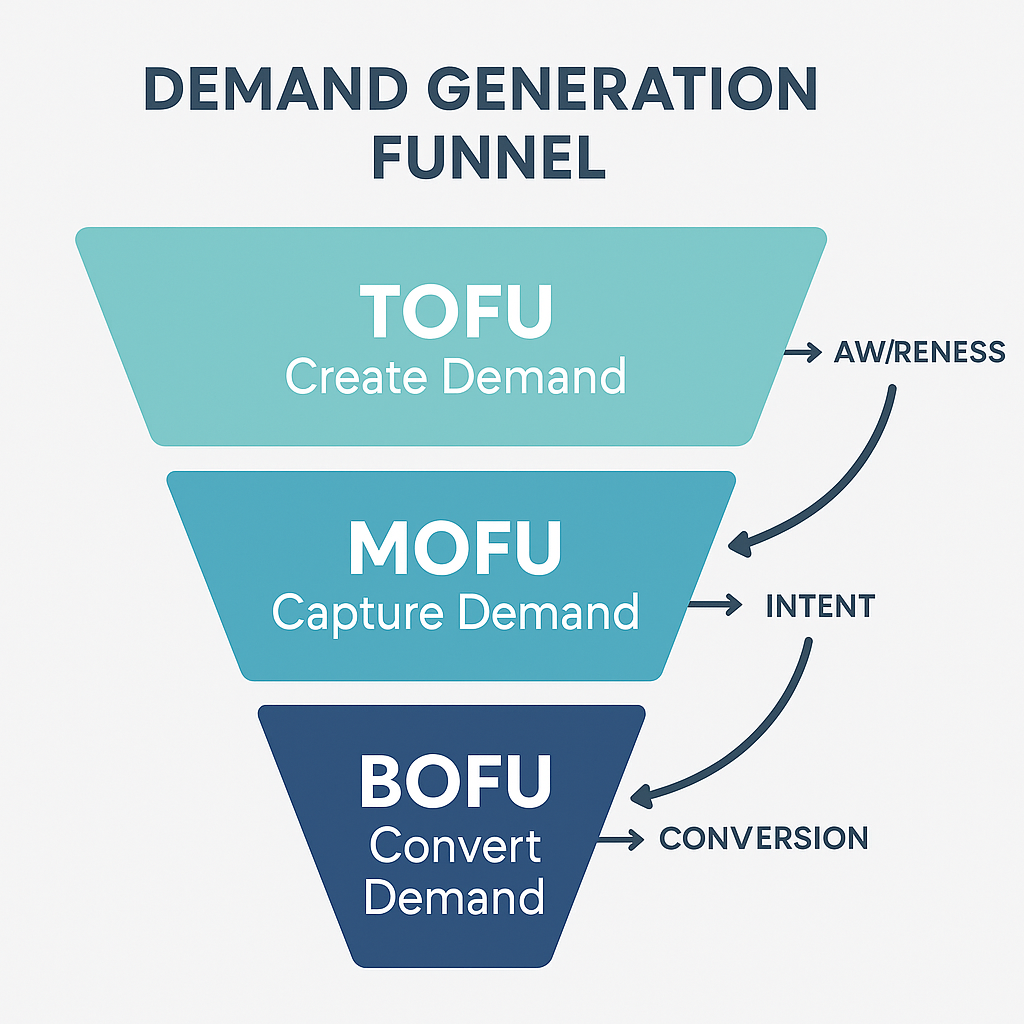
Stage 2 – Capture Demand (BOFU / High Intent)
Once awareness has been created, the next step is to capture demand from the 5% of the market actively seeking a solution.
Tactics:
Focus on high-intent channels like Google Search, G2, Capterra, and LinkedIn retargeting.
Showcase pricing, product comparisons, and ROI calculators on landing pages.
Offer consultations, free trials, and demos for qualified buyers.
Use retargeting campaigns to re-engage site visitors who showed buying signals.
Goal: Turn interest into action, form submissions, booked calls, or signups.
Pair your content intent with your call-to-action (e.g., demo CTAs on pricing pages, not blogs).
Stage 3 – Convert Demand (MOFU)
The middle-to-bottom of the funnel is where marketing hands off to sales and the focus shifts to conversion efficiency.
Key Actions:
Implement a smooth pipeline handoff between marketing and sales teams.
Use CRM integration for a unified customer view (HubSpot, Salesforce, SalesEcho).
Streamline the sales process for speed, clarity, and repeatability.
Personalize outreach based on behavioral signals and content engagement.
Smooth marketing-to-sales handoff = shorter sales cycle and higher close rate.
Middle of the Funnel (MOFU) Bridge
This stage often goes unnoticed but is essential for trust-building and evaluation.
Your prospects are aware of their problem, now they’re deciding who to trust with the solution.
Content that works best here:
Customer success stories and testimonials
Comparison sheets and ROI calculators
Product explainer videos or behind-the-scenes webinars
Strategic nurturing emails guiding toward demos or trials
Goal: Move prospects naturally from learning to engaging in a sales conversation, without pressure.
Core Components of a B2B Demand Generation Strategy
A winning B2B demand generation strategy doesn’t rely on one campaign or channel — it’s a structured system that connects audience insights, data-driven execution, and consistent storytelling. Below are the core components (or pillars) that power sustainable growth in modern B2B marketing.
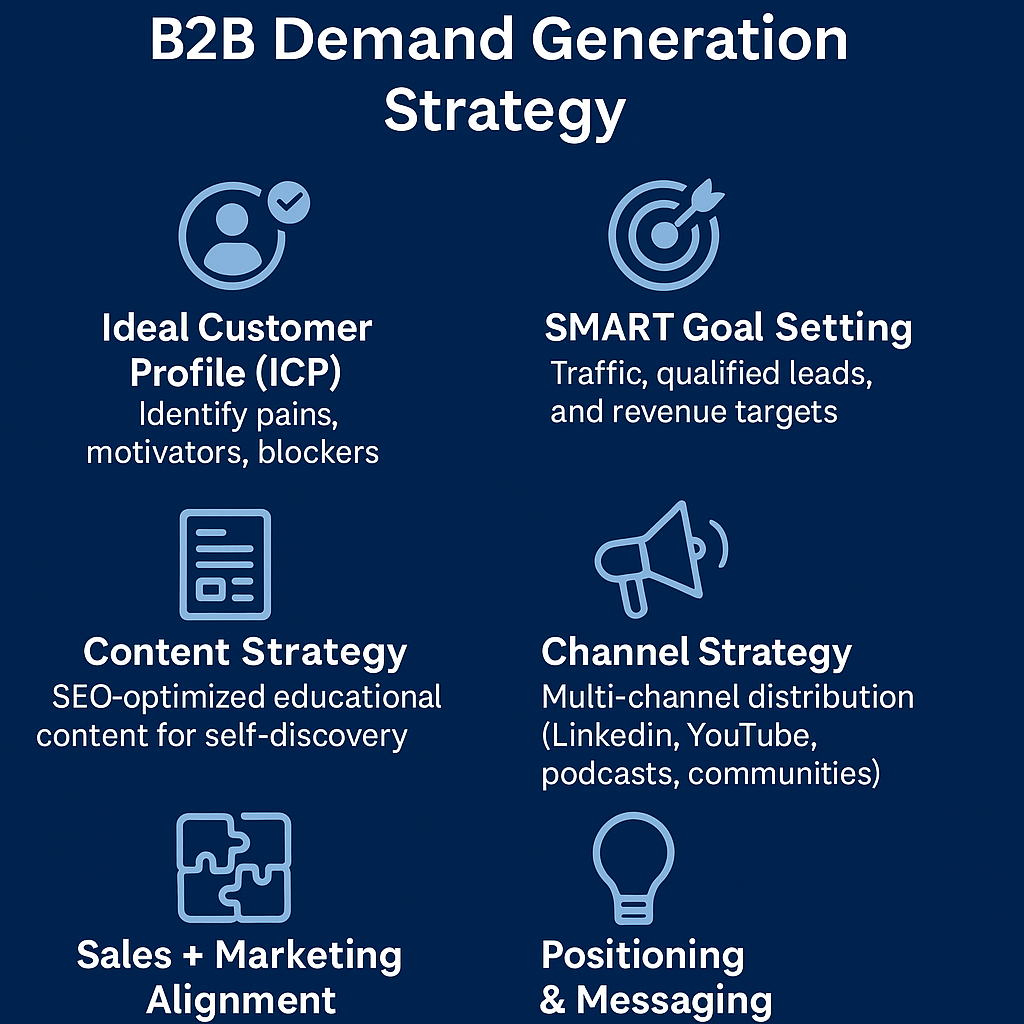
1. Ideal Customer Profile (ICP)
Your ICP is the foundation of every demand generation campaign. It helps you focus your marketing budget on accounts that actually have buying potential.
How to build it:
Identify pains, motivators, blockers, and shifts in customer behavior.
Use a five-factor ICP guide: goals, challenges, triggers, buying power, and success criteria.
Map your customer’s journey design to align content with each stage (awareness → intent → purchase).
Pro Tip: The sharper your ICP, the stronger your channel targeting and message relevance.
2. SMART Goal Setting
Set Specific, Measurable, Achievable, Relevant, and Time-bound goals that define what “success” looks like.
Examples:
Increase organic traffic by 40% in 90 days.
Generate 200 qualified leads per quarter.
Achieve a 3:1 pipeline-to-revenue ratio.
These KPIs tie marketing performance directly to business growth, ensuring accountability and ROI tracking.
3. Content Strategy
Content is the engine of B2B demand generation marketing — it attracts, educates, and nurtures future buyers.
Key Elements:
Create SEO-optimized educational content for self-discovery (blogs, guides, webinars).
Blend thought leadership (future insights) with problem-solution storytelling (practical value).
Focus on ungated assets to increase reach and trust, then nurture interest with deeper gated materials later.
The best B2B content doesn’t sell — it teaches, empowers, and earns attention.
4. Channel Strategy
Your distribution matters as much as your content. To win in demand generation, go where your ICP already spends time.
Best-performing channels:
LinkedIn: Strategic posting, employee advocacy, and paid campaigns.
YouTube: Explainer videos, case studies, and how-to tutorials.
Podcasts: Thought leadership conversations to build trust.
Communities: Slack groups, Reddit, or niche forums where buyers share advice.
Framework: “Right ICP → Right Message → Right Channel → Right Time.”
5. Sales + Marketing Alignment
True demand generation can’t thrive if your sales and marketing teams operate in silos.
Action Steps:
Set shared KPIs like pipeline contribution, MQL-to-SQL conversion rate, and revenue sourced.
Hold joint review sessions to analyze deal quality and lead scoring accuracy.
Use data-driven dashboards (SalesEcho, HubSpot, or Dreamdata) for unified tracking.
Stat Insight: Companies with strong marketing–sales alignment see 67% higher deal closure rates (LinkedIn B2B Institute).
6. Positioning & Messaging
Your positioning defines how the market perceives you — your messaging tells them why it matters.
Best practices:
Craft a clear value proposition that shows how you’re different (not just cheaper).
Tailor tone and language to your ICP’s priorities.
Validate messaging with customer interviews and A/B tests.
Mini Framework: “Value > Features > Proof.”
7. Conversion Optimization
All your demand efforts fall short without smooth conversion paths.
Focus on:
Fast-loading, mobile-friendly pages with intuitive UX.
Proof-driven CTAs — use testimonials, case studies, or client logos.
Personalized nurture flows for demo requests or trial signups.
Pro Tip: A simple form with two fields can increase demo signups by up to 30%.
Proven B2B Demand Generation Tactics (2026 Edition)
In the modern AI-driven landscape, B2B buyers no longer move linearly through the funnel. Winning brands combine education, engagement, and evidence through creative, omnichannel strategies that build trust before conversion.
1. Content Capsule (MOFU Focus)
The middle of the funnel is where curiosity turns into credibility.
Here, you bridge the gap between awareness and intent by sharing stories that educate and prove your product’s value.
Tactics:
Craft problem-unaware → solution-aware storytelling that helps audiences realize their challenges.
Share real product use cases, not just features — show transformation.
Publish customer data stories and quantified outcomes.
Create value-proposition content that answers: “Why us vs. others?”
Repackage your strongest mid-funnel assets (e.g., case studies, comparison pages, or ROI breakdowns) into short-form videos and carousel posts on LinkedIn.
2. Key Channels & Activities
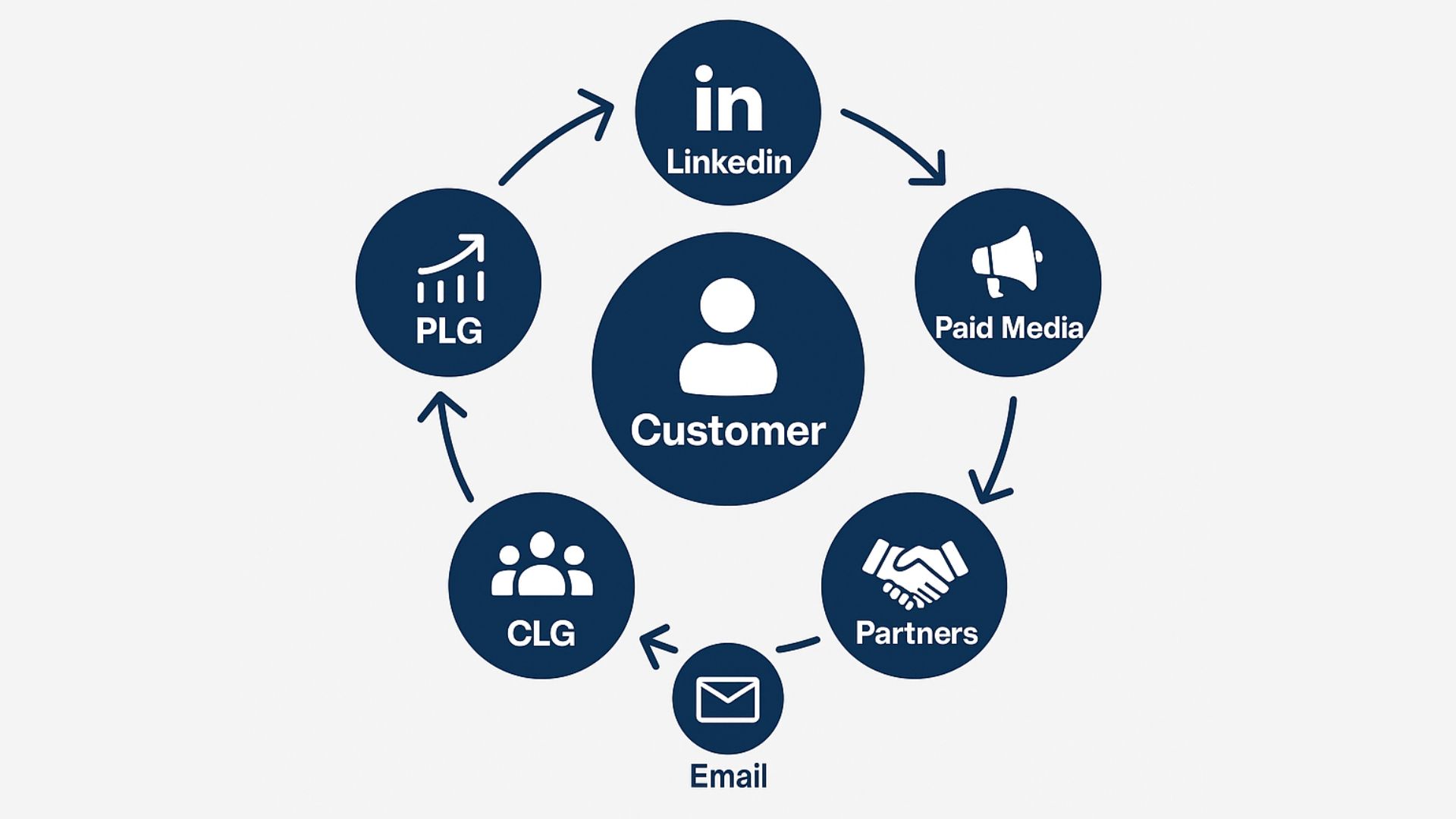
The most effective B2B demand generation programs don’t rely on a single channel — they orchestrate multiple, working together.
Top Channels:
LinkedIn Thought Leadership: Build authority through strategic posting, employee advocacy, and expert commentary.
Paid Media (Social, PPC, ABM Ads): Use precise targeting to stay top-of-mind among ICP accounts.
Email Drip Programs & Personalization: Send tailored sequences based on lead behavior and buying stage.
Product-Led Growth (PLG) / Freemium Models: Let users experience your value before they pay.
Community-Led Growth (CLG): Engage with active communities for organic credibility and peer validation.
Partner & Referral Programs: Leverage networks for warm introductions and extended reach.
Use dark social tracking (LinkedIn shares, Slack mentions, podcast mentions) to measure unseen influence — it’s where modern B2B trust is built.
3. Building Trust (Especially for Early-Stage Brands)
In early-stage B2B companies, trust is the differentiator. You’re not just selling a solution — you’re proving credibility.
Key Trust Builders:
Founder Visibility on LinkedIn: Share insights, learnings, and behind-the-scenes product growth stories.
Influencer & Advisor Partnerships: Collaborate with niche experts who already have your ICP’s trust.
Customer Communities: Build safe, interactive spaces (Slack, Discord, or Circle) where users share wins and advice.
Social Proof Loop: Turn every customer success story into social content and testimonial snippets.
Your most powerful B2B marketing asset isn’t your product — it’s proof that others believe in it.
Measuring B2B Demand Generation Success
In B2B marketing, success isn’t measured by vanity metrics like clicks or impressions, it’s measured by pipeline, revenue, and trust.
A modern demand generation strategy blends quantitative and qualitative signals to track how awareness, engagement, and intent translate into real business outcomes.
Revenue-Focused Metrics
A healthy demand generation program drives measurable business impact. These are the core metrics every B2B marketer should track:
1. Marketing-Generated Revenue (MGR)
This is the ultimate indicator of success, how much revenue your marketing activities directly generate.
It ties all campaigns, content, and paid initiatives back to pipeline contribution and deal creation.
Goal: Make “marketing as a revenue engine,” not a cost center.
2. MQL-to-SQL Conversion Rate
Measures how effectively your leads move from marketing-qualified (MQL) to sales-qualified (SQL).
High conversion rates mean your targeting and lead scoring are aligned with real buyer intent.
Formula: SQL ÷ MQL × 100
3. Opportunities / Pipeline Created
Tracks how many new opportunities were generated through demand gen activities — and how much pipeline value they represent.
A strong pipeline is the bridge between marketing influence and sales performance.
4. Cost per Acquisition (CPA) & Customer Lifetime Value (LTV)
These two metrics define efficiency and sustainability.
CPA: What it costs to acquire one paying customer.
LTV: The total revenue a customer generates over their lifetime.
A winning B2B demand strategy keeps LTV > 3× CPA for healthy unit economics.
5. Demand Gen Cycle Length (Time to Customer)
Tracks how long it takes a prospect to move from first touch to closed deal.
Shorter cycles = stronger alignment, more efficient nurturing, and higher conversion probability.
When your demand engine is working, you’ll notice pipeline velocity improving — not just lead volume.
Attribution & Optimization
Traditional attribution models (first-touch, last-touch) miss the real story — especially in today’s multi-channel, dark social environment.
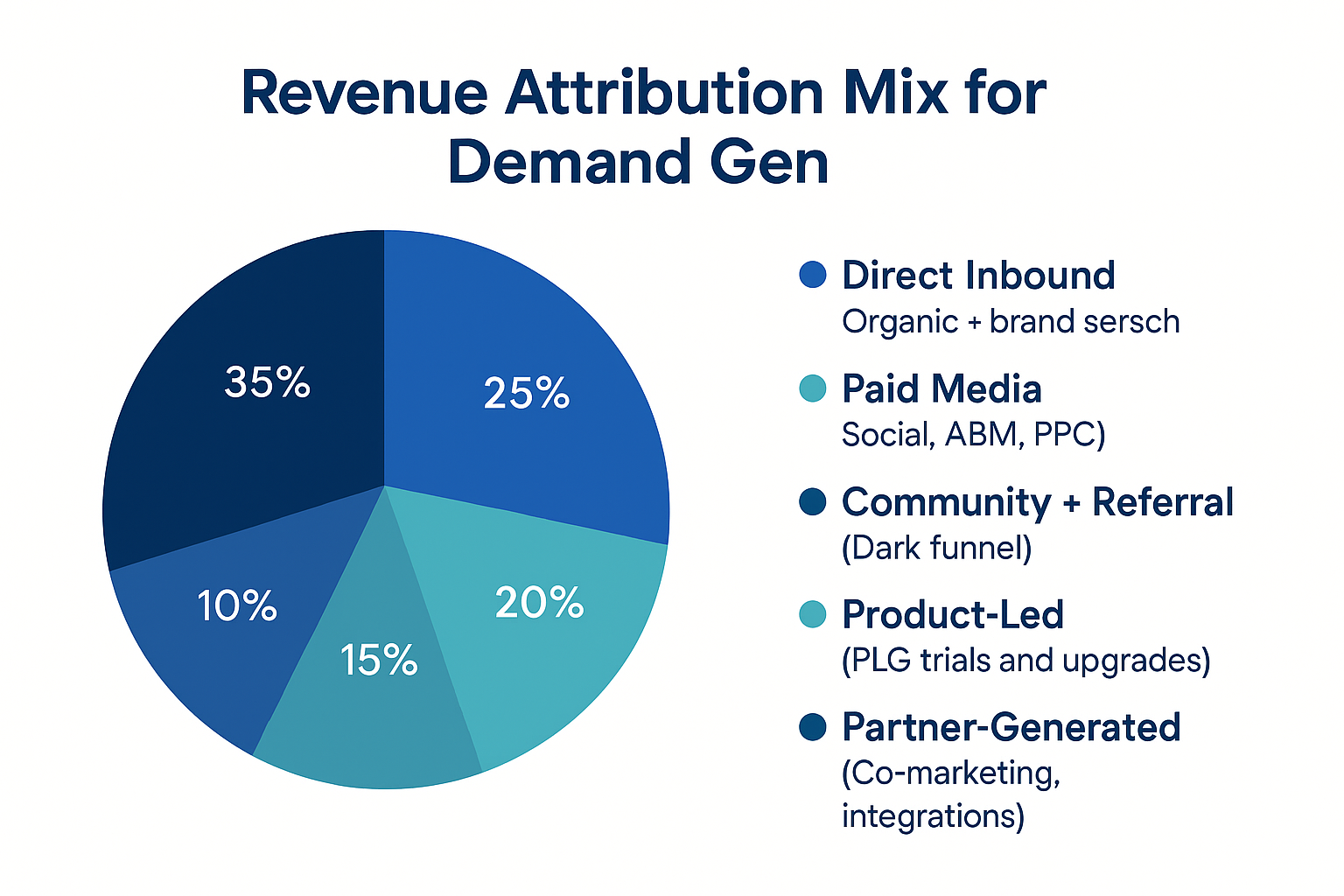
True measurement means understanding both visible and invisible buyer signals.
1. Self-Reported Attribution (“How did you hear about us?”)
Don’t underestimate this simple question — it uncovers the “dark funnel” influences (LinkedIn posts, podcasts, Slack groups) that analytics can’t track.
2. Hidden “Dark Funnel” Signals (Community Engagement)
Buyers research quietly before they engage.
Track qualitative cues like:
Mentions in Slack communities
Engagement on social posts
Repeat visits to ungated content
Referrals through partner ecosystems
3. A/B Testing CTAs and Creatives
Regularly test your copy, visuals, and CTAs across ads, emails, and landing pages.
Even a 10% improvement in CTR or form completion rate can significantly increase pipeline over time.
4. Brand Lift Studies & Traffic Quality
Go beyond click metrics — evaluate how your campaigns shift perception.
Use brand lift surveys or compare direct traffic and branded search volume before and after major campaigns to assess awareness impact.
Not everything measurable matters, and not everything that matters is measurable — but attribution brings you closer to the truth.
Adapting Demand Generation for the AI Era
AI has reshaped how B2B marketers create, test, and scale demand. The winners in this new era aren’t those who talk the most about AI — they’re the ones who use it to accelerate insight, personalize engagement, and refine messaging in real time.
Here’s how to adapt your demand generation strategy to thrive in the fast-moving, AI-driven landscape of 2026 and beyond.
1. Messaging Iteration at Turbo Speed
AI tools enable marketers to analyze buyer signals, iterate campaigns, and refresh messaging faster than ever.
But this velocity demands precision — not noise. Update your content and positioning as your product evolves, and ensure every iteration aligns with buyer pain points, not just tech hype.
AI-driven chatbots may change weekly — but your narrative should always connect to customer outcomes, not model updates.
2. Master the Double-Edged Sword of AI Messaging
“AI” has become both a buzzword and a barrier. To stand out, you must translate the tech into tangible impact for two distinct audiences:
Appeal to Executives: Focus on outcomes that drive ROI, cost efficiency, and team productivity.
Example: “Reduce deal cycles by 30% through AI-powered call analysis.”
Appeal to End-Users: Emphasize how AI makes their jobs simpler, more strategic, and less repetitive.
Example: “Free your sales team from admin work so they can close more deals.”
AI sells when it feels human.
3. Strong Hypothesis Required — Test Before Scaling
In AI-powered demand gen, testing is everything.
Treat every campaign like an experiment:
Form a clear hypothesis (“AI-driven personalization improves demo conversions by 20%”).
Test quickly.
Scale only what’s proven.
Framework: Launch → Measure → Learn → Optimize → Scale.
4. AI Is a Feature, Not the Value Proposition
Many brands fall into the trap of leading with the word “AI.”
Buyers don’t buy algorithms, they buy solutions that solve real pain points.
Your messaging should highlight results: time saved, revenue generated, or efficiency unlocked, not the tech itself.
Shift your narrative:
❌ “We use advanced AI models to analyze sales calls.”
✅ “We help sales teams respond faster and close smarter — powered by AI.”
5. Build Trust on Outcomes, Not Algorithms
AI skepticism is real — especially among enterprise buyers.
Earn credibility by showing proof, not promises.
Share transparent case studies.
Highlight measurable outcomes, not model complexity.
Offer explainable insights, not black-box jargon.
AI won’t sell your solution — clarity will.
Common Challenges & How to Fix Them
Even the best B2B demand generation strategies hit roadblocks.
The key is not avoiding these challenges — it’s recognizing them early and course-correcting fast.
Here are the most common pitfalls and how to overcome them in today’s data-driven, AI-shaped landscape.
1. Misalignment Between Marketing and Sales
The challenge: Marketing teams generate leads that sales doesn’t prioritize — or sales pursues accounts marketing never targeted.
The fix:
Define shared KPIs such as pipeline influence, conversion rates, and deal velocity.
Set up joint review cadences to evaluate lead quality and attribution accuracy.
Implement CRM visibility so both teams operate from a single source of truth.
Pro Tip: When marketing and sales track “pipeline created,” not just “leads handed off,” conversion rates climb by up to 67%.
2. Over-Reliance on MQLs vs. Revenue Metrics
The challenge: Many teams still celebrate form fills instead of measuring actual revenue impact.
The fix:
Shift focus from volume-based MQLs to revenue-based outcomes.
Use split-funnel analysis to separate awareness influence from opportunity creation.
Optimize around opportunity rate, cost per pipeline dollar, and marketing-generated revenue.
Mindset shift: “Not all leads matter — only the ones that close.”
3. Gated Content Fatigue
The challenge: Audiences have grown weary of forms. Gated content can restrict reach and damage trust if overused.
The fix:
Un-gate early-stage content (guides, checklists, podcasts) to maximize discovery.
Save gating for high-intent assets like demos or ROI calculators.
Use progressive profiling to capture data over time, not all at once.
Result: Ungated content builds authority faster and doubles organic engagement.
4. Failure to Adapt Messaging to AI Buyers
The challenge: AI-native buyers are skeptical of jargon and promises that don’t translate to real outcomes.
The fix:
Lead with specific benefits (“save 10 hours per rep per week”) instead of abstract AI terms.
Customize content for both executive ROI seekers and end-user problem solvers.
Update messaging quarterly to align with how your ICP’s use of AI evolves.
Rule of thumb: “If your AI message can fit any product, it’s too generic.”
5. Lack of Community Presence (The Dark Funnel Blind Spot)
The challenge: Your audience’s most valuable buying signals often happen in private communities — Slack groups, LinkedIn DMs, or niche forums — beyond traditional tracking.
The fix:
Invest in community-led growth (CLG) strategies by engaging authentically where your ICP hangs out.
Encourage employee advocacy and founder-led visibility on social platforms.
Track dark funnel impact via self-reported attribution and referral mentions.
Takeaway: “If you’re not part of the conversation, you’re invisible when buying intent peaks.”
Example Demand Generation Campaigns That Work
Nothing builds trust like proof. Below are real-world B2B demand generation campaigns — including how SalesEcho and other leading brands turned awareness into measurable, repeatable revenue.
1. SalesEcho: Real-Time Intent Signals and AI-Guided Follow-Ups
What we do: SalesEcho helps B2B sales and marketing teams identify when high-intent accounts are ready to engage and guides reps with real-time AI prompts during live calls.
Why it works: Instead of relying on delayed lead scoring or static MQLs, SalesEcho surfaces in-the-moment buying signals — website visits, call sentiment, keyword triggers — empowering reps to act when interest peaks.
Key takeaway: Speed + context = conversions. Acting in real time transforms outreach from cold to contextual, lifting pipeline velocity by up to 40%.
2. Cognism: Split-Funnel Model for Pipeline Clarity
What they did: Cognism split its marketing funnel into two distinct tracks — awareness and conversion — to measure each one’s contribution to revenue separately.
Why it worked: This split-funnel approach helped them see not just who converted, but what built intent along the way.
It allowed better forecasting and more accurate ROI reporting for demand gen activities.
Key takeaway: Treat upper- and lower-funnel metrics differently — but track both rigorously.
3. Drift: Conversational Marketing for Lead Acceleration
What they did: Drift replaced traditional lead forms with conversational chatbots to start real-time discussions with prospects on-site.
Why it worked: Visitors could book demos instantly, creating a 50% increase in qualified meeting volume. The “conversation-first” model also gave Drift direct insights into buying triggers.
Key takeaway: Conversations create conversions — automate intelligently, not impersonally.
4. HubSpot: Educational Ecosystem Strategy
What they did: HubSpot pioneered an education-first demand model using blogs, certifications, and free tools that teach marketing best practices.
Why it worked: By nurturing trust early, HubSpot became the default choice for marketers seeking inbound growth — effectively turning education into long-term demand.
Key takeaway: Teach, don’t chase. The brand that educates best wins the buyer’s trust — and their budget.
Tools & Platforms for B2B Demand Generation
Modern demand generation isn’t about a single platform — it’s about a stack that connects data, personalization, and timing.
Below are the most essential categories and tools shaping how B2B teams create, capture, and convert demand in 2026.
Category | Top Tools / Platforms | Primary Use Case | Why It Matters |
|---|---|---|---|
SalesEcho (Real-Time Sales Coaching) | Real-time sales intelligence, call prompts, and AI-guided follow-ups | Empowers reps to act on live intent data and improve conversion velocity | |
CRM | HubSpot, Salesforce | Lead management, pipeline tracking, automation | The backbone of your demand system — centralizes data and workflows |
ABM (Account-Based Marketing) | 6sense, Demandbase, Terminus | Target high-value accounts with personalized ads and insights | Aligns marketing and sales around shared ICPs and buying signals |
Analytics & Attribution | Factors.ai, Dreamdata | Multi-touch attribution, campaign ROI tracking | Reveals which channels actually drive revenue — not just clicks |
Visitor Identification | Knock Reveal, Leadfeeder | Identify anonymous website visitors and enrich firmographic data | Converts unknown traffic into actionable opportunities |
Related: Best Sales Intelligence Tools
FAQs
1. What is B2B demand generation in marketing?
B2B demand generation is a marketing strategy focused on creating awareness, interest, and intent among potential buyers before they’re ready to purchase. It builds trust through education and content, laying the foundation for long-term revenue growth.
2. How does B2B demand gen differ from lead generation?
Demand generation nurtures audience awareness and interest over time, while lead generation focuses on capturing contact information through gated offers. Demand gen builds brand equity, lead gen captures short-term conversions — both are vital, but they serve different stages of the funnel.
3. What are the best B2B demand generation strategies for 2026?
The top-performing strategies include:
AI-assisted personalization (SalesEcho)
Ungated educational content
Community-led growth (CLG)
ABM targeting with intent data
Video and podcast storytelling
These methods create organic trust and attract ready-to-buy audiences faster.
4. Which tools help create a demand generation campaign?
Key tools across categories:
AI Assistants: SalesEcho
CRM: HubSpot, Salesforce
ABM Platforms: 6sense, Demandbase
Analytics: Factors.ai, Dreamdata
Visitor ID: Knock Reveal, Leadfeeder
Together, they form a full-stack ecosystem for planning, executing, and optimizing campaigns.
5. What metrics define demand generation success?
Track metrics that tie marketing to revenue, such as:
Marketing-Generated Revenue (MGR)
Pipeline Created
MQL-to-SQL Conversion Rate
Customer Lifetime Value (LTV)
Demand Gen Cycle Length
These reveal efficiency, ROI, and long-term growth impact.
6. How to build a B2B demand gen team structure?
A strong team includes:
Demand Gen Manager (strategy + execution)
Content Lead (educational and conversion assets)
Paid Media Specialist (ads, ABM, retargeting)
Marketing Ops (CRM, attribution, automation)
Sales Enablement (handoff alignment + feedback loop)
7. What does a demand generation manager do?
A demand generation manager develops and executes campaigns that drive qualified pipeline. They oversee content, paid media, analytics, and automation — bridging the gap between marketing performance and sales outcomes.
8. How to generate demand organically without ads?
Publish SEO-optimized blogs and guides
Share value-driven insights on LinkedIn and communities
Launch free tools, templates, or resources
Use email nurturing to convert awareness into action
Organic demand takes longer but builds lasting authority and engagement.
9. What is demand creation vs demand capture?
Demand creation builds awareness among audiences who don’t yet realize they have a problem.
Demand capture focuses on those already searching for a solution.
Both are critical: creation expands your market; capture converts existing intent.
10. How is AI transforming B2B demand generation today?
AI enables real-time personalization, predictive targeting, and performance optimization.
Tools like SalesEcho detect live intent signals and coach reps in real time, making every buyer interaction smarter, faster, and more human.