
SaaS Marketing: Strategy, Frameworks & Proven Playbook for 2026
 Rishabh Jain
TL;DR
SaaS marketing is the discipline of promoting subscription-based software through consistent value delivery, customer retention, and data-driven growth.
In 2026, the most effective SaaS marketing strategies unite AI-powered personalization, community-led trust, and evidence-based storytelling to strengthen both Monthly Recurring Revenue (MRR) and Customer Lifetime Value (LTV).
The focus has evolved from acquiring leads to earning loyalty, building sustainable relationships that compound revenue over time.
What Is SaaS Marketing?
SaaS Marketing Definition
SaaS marketing (Software as a Service marketing) refers to the process of promoting subscription-based software that customers access through the cloud.
Instead of driving one-time purchases, SaaS marketers focus on recurring value, long-term retention, and customer activation across the entire lifecycle.
In essence, it’s about educating prospects, nurturing trust, and positioning the software as an ongoing solution, not just a product.
Modern SaaS marketing strategies combine product-led growth (PLG), content-driven awareness, and data-backed personalization to build predictable revenue streams.
In short:
SaaS marketing is less about selling software and more about proving its value — month after month.
Primary focus areas:
Recurring revenue models (MRR/ARR)
Product-Led Growth (PLG) and onboarding
Customer retention and renewals
How SaaS Marketing Differs from Traditional Marketing
While traditional marketing aims for one-time conversions, SaaS marketing focuses on continuous engagement and customer lifetime value.
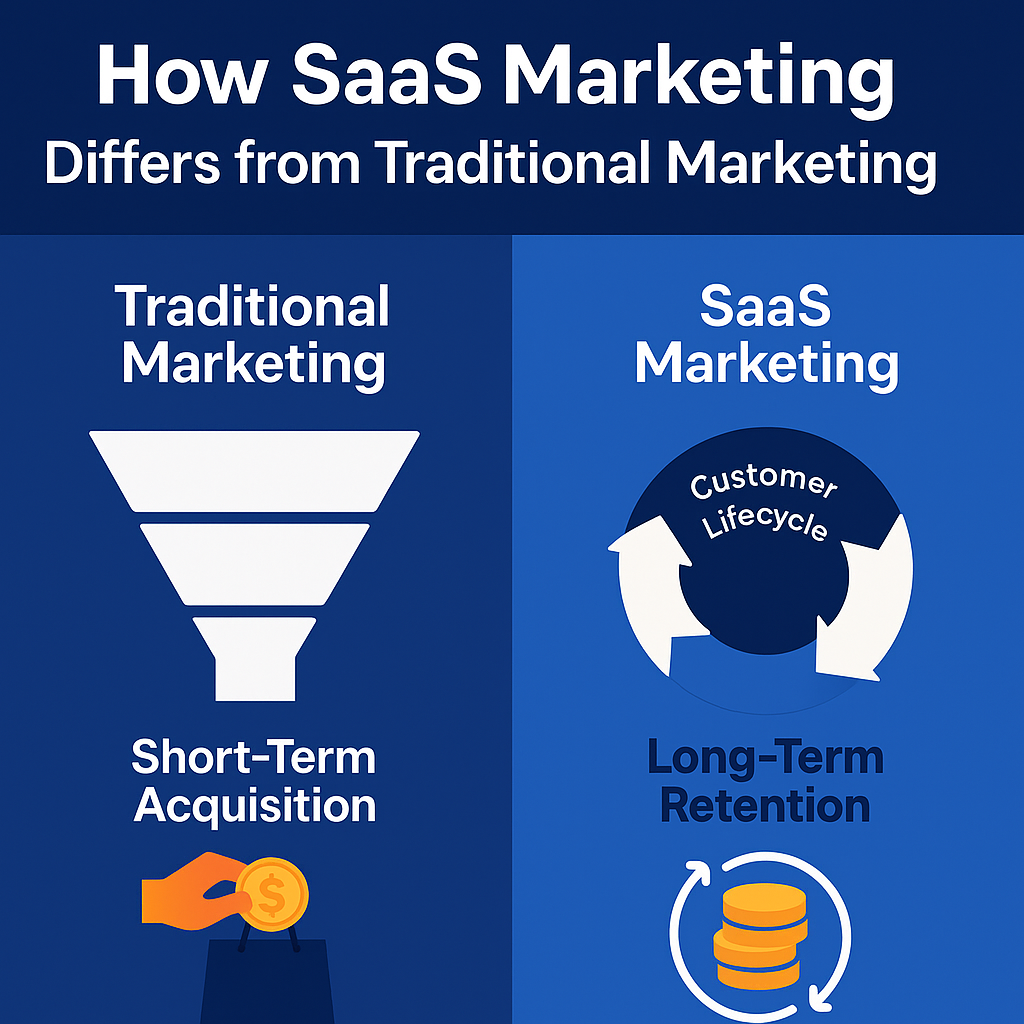
Aspect | Traditional Marketing | SaaS Marketing |
|---|---|---|
Goal | Drive immediate sales | Build recurring revenue and retention |
Customer Journey | Linear: awareness → purchase | Cyclical: awareness → activation → renewal |
Product Type | Physical / finite | Cloud-based, subscription model |
Sales Cycle | Short-term | Long-term, consultative |
Success Metric | Conversions | Lifetime value (LTV), churn, MRR growth |
Marketing Focus | Awareness and offers | Education, onboarding, customer success |
SaaS companies also tend to rely on freemium models, demos, and trials to generate pipeline — turning user experience itself into the strongest marketing channel.
In short:
Traditional marketing sells transactions; SaaS marketing builds relationships.
Why SaaS Marketing Matters in 2026
In 2026, SaaS marketing has become more critical than ever — not because software is scarce, but because attention is. With thousands of SaaS tools competing for the same buyers, differentiation now comes from experience, clarity, and consistency, not features alone.
1. Global SaaS Competition = Attention Deficit Market
Buyers are overwhelmed by choice. The average B2B decision-maker evaluates 8–10 tools before committing to one. Modern SaaS marketing must therefore capture attention early, nurture trust across channels, and prove value before the trial even begins.
2. Self-Serve and Product-Led Growth Are Now Default
Nearly 70% of SaaS users prefer to explore software on their own through free trials, freemium tiers, or interactive demos.
The role of marketing has shifted — from persuasion to facilitation. Marketers now guide users through hands-on product experiences that drive conversions naturally.
3. Retention Is the New Acquisition
With paid ad costs rising and inbox competition at its peak, sustainable growth comes from keeping customers longer, not chasing new ones faster.
Reducing churn and improving onboarding directly improves CAC efficiency, as loyal users generate referrals, testimonials, and upsells — creating a compounding effect on growth.
The best SaaS marketers don’t sell software — they sell transformation.
SaaS Marketing Funnel & Model
A successful SaaS marketing strategy doesn’t end at sign-up — it continuously moves users through a cyclical growth model that drives activation, retention, and advocacy.
Unlike traditional funnels that stop at conversion, the SaaS marketing funnel operates more like a flywheel — where every satisfied customer fuels future growth.
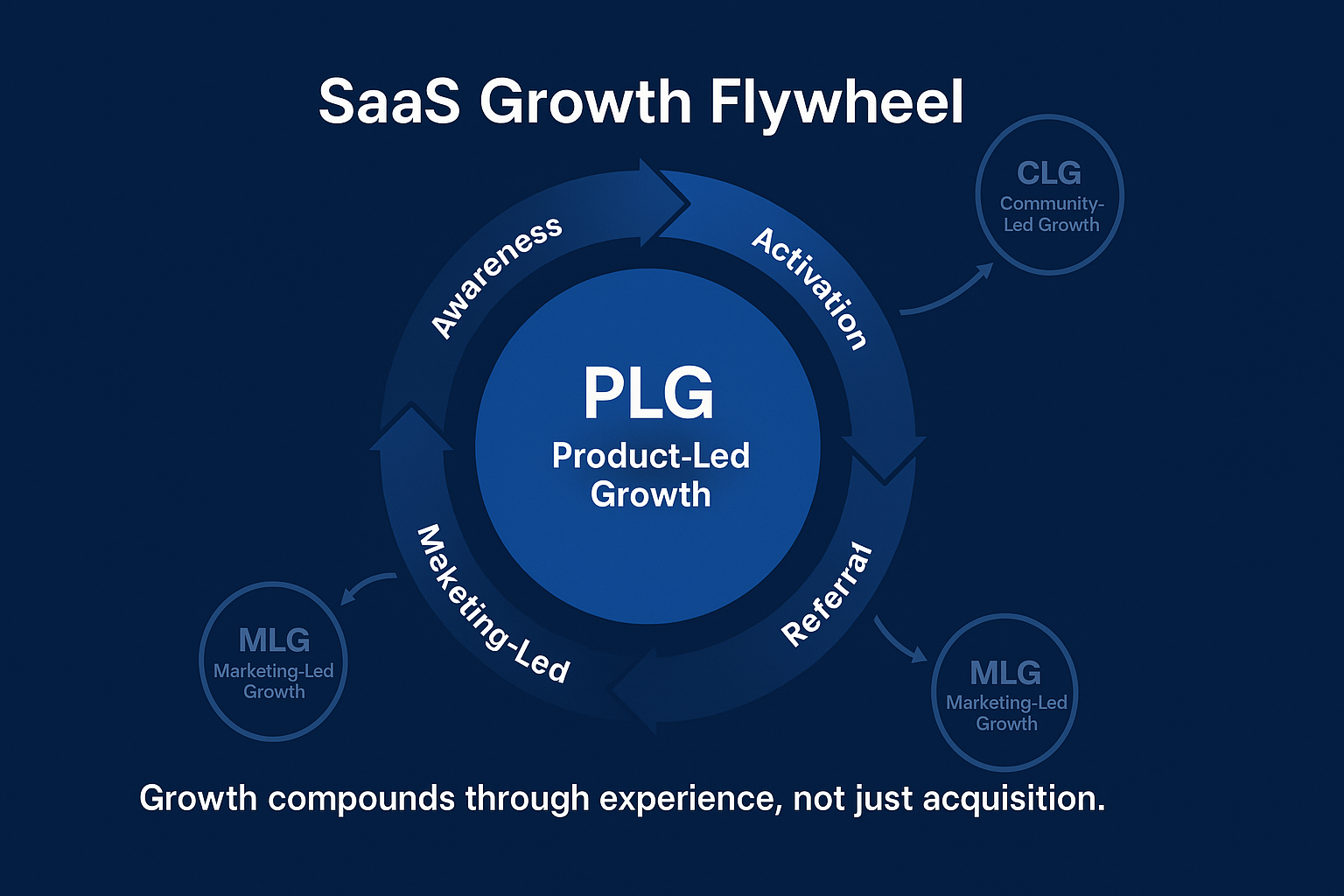
Awareness → Activation → Retention → Referral
Each stage serves a distinct purpose and requires its own tactics:
TOFU (Top of Funnel) — Awareness
Goal: Attract prospects who are problem-aware but not yet solution-aware.
Tactics: SEO-optimized blogs, paid ads (PPC, LinkedIn), and brand-building campaigns.
Example: HubSpot uses educational content to draw top-funnel interest.
MOFU (Middle of Funnel) — Activation
Goal: Turn curiosity into hands-on engagement.
Tactics: Free trials, product demos, onboarding sequences, and personalized email drips.
Example: Canva’s free tier converts users through value-first design tools.
BOFU (Bottom of Funnel) — Conversion & Upsell
Goal: Convert high-intent users into paying customers and nurture upgrades.
Tactics: Case studies, ROI calculators, testimonials, and time-limited offers.
Example: Drift leverages conversational demos that close deals in-chat.
Retention — Support, Community & Expansion
Goal: Keep users loyal, engaged, and expanding usage.
Tactics: Active customer success teams, user communities, referral programs, and tiered upgrades.
Core SaaS Marketing Metrics & KPIs
In SaaS marketing, success isn’t just about acquisition — it’s about sustained, measurable growth.
These core metrics form the foundation of every data-driven SaaS marketing strategy, helping teams balance revenue, retention, and long-term scalability.
1. MRR / ARR — The Revenue Foundation
Monthly Recurring Revenue (MRR) and Annual Recurring Revenue (ARR) are the lifeblood of any SaaS business.
They reflect predictable, compounding income from subscriptions — the ultimate indicator of stability and scale.
Healthy SaaS companies grow MRR 10–20% month-over-month in early stages.
2. CAC & LTV — The Growth Efficiency Ratio
Customer Acquisition Cost (CAC) shows how much it costs to acquire one paying user.
Lifetime Value (LTV) measures total revenue generated per customer.
The goal? Maintain at least a 3:1 LTV:CAC ratio — meaning every dollar spent on acquisition returns three in revenue.
3. Churn Rate — The Retention Health Check
Churn measures the percentage of customers who cancel subscriptions during a given period.
A high churn rate signals product or engagement gaps.
Top SaaS brands focus on sub-5% churn by improving onboarding, support, and customer success.
A 5% churn reduction = 25–95% profit boost (Bain study).
4. NRR (Net Revenue Retention) — The SaaS Gold Metric
NRR captures how much recurring revenue you retain — and expand — from existing customers.
An NRR above 100% means your company is growing even without new customers, thanks to upsells, cross-sells, and renewals.
5. NPS — Brand Advocacy in Action
The Net Promoter Score (NPS) measures how likely customers are to recommend your product.
A high NPS signals strong brand trust — the foundation for organic referrals, community growth, and word-of-mouth demand.
6. Lead Velocity Rate (LVR) — Predictive Growth Signal
LVR tracks the rate of growth in qualified leads month-over-month, forecasting future pipeline health.
It helps marketing and sales align on forward momentum rather than lagging performance.
Building a SaaS Marketing Strategy (Step-by-Step Framework)
A strong SaaS marketing strategy aligns audience insight, product positioning, and continuous optimization.
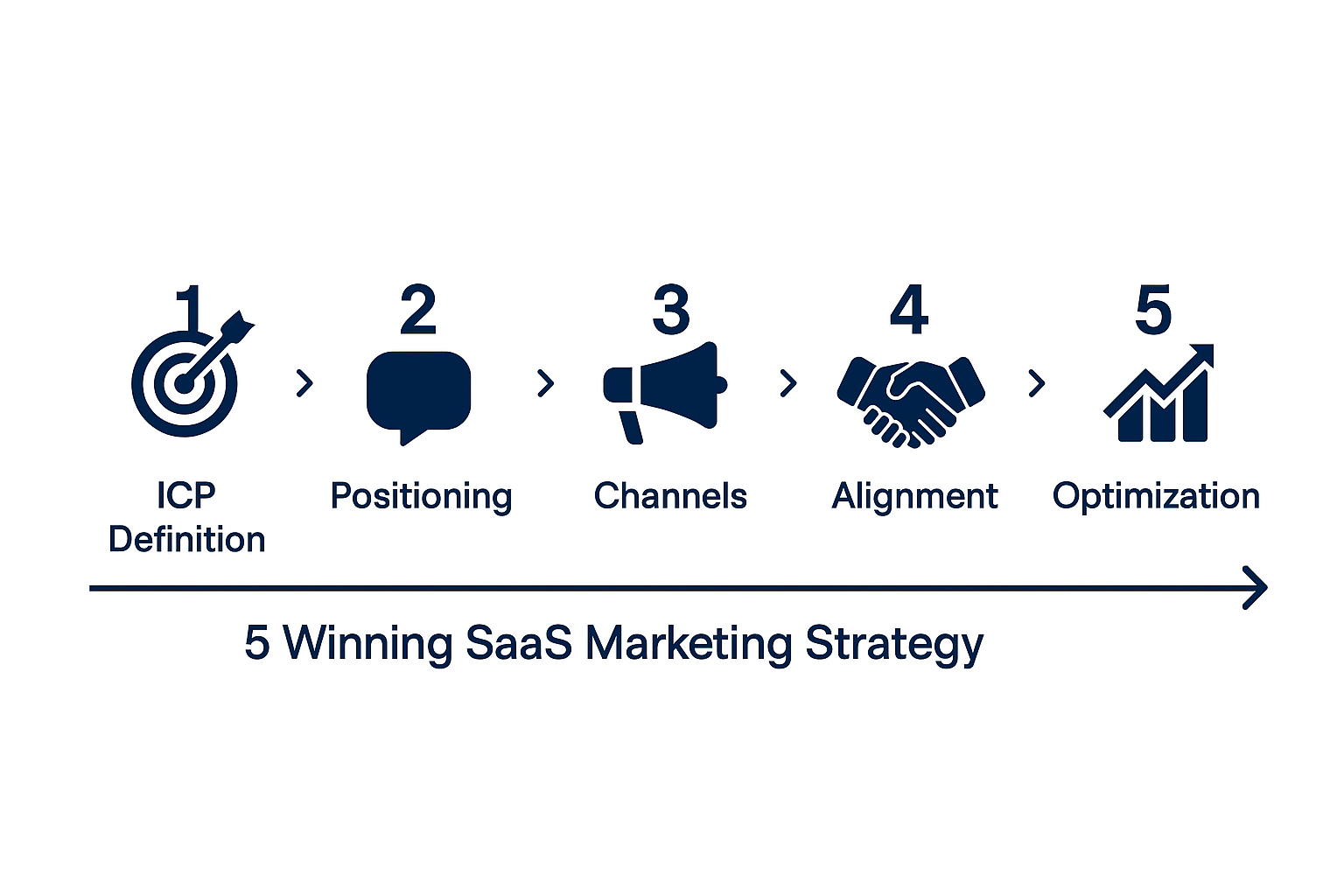
Unlike traditional campaigns, SaaS growth depends on precision — right ICP, right message, right channel, right time.
Here’s a proven 5-step framework used by top-performing SaaS teams:
Step 1 – Define Your ICP and Buyer Personas
Start with data, not guesswork.
Use intent signals, firmographics, and behavioral triggers to define your Ideal Customer Profile (ICP).
Segment users based on role, company size, and pain points to build hyper-relevant campaigns.
Tip: Combine CRM and website analytics to identify who’s engaging, not just who’s visiting.
Step 2 – Develop Positioning & Messaging
Your messaging must connect value to outcomes — not just features.
Highlight why your software matters: efficiency gained, cost saved, or performance improved.
Use ROI-focused narratives and proof points (case studies, testimonials, data visuals).
People buy clarity, not complexity. Show results, not roadmaps.
Step 3 – Choose a Channel Mix
Every SaaS audience behaves differently — test, measure, and double down on what works.
Popular high-ROI channels include:
SEO: Evergreen visibility through organic content
PPC: Fast-tracked intent capture (Google Ads, LinkedIn)
Social Media: Awareness and authority building
Email Marketing: Lifecycle nurturing and upsells
Affiliate & Partner Marketing: Community-driven reach
Step 4 – Align Sales + Marketing
Silos kill momentum.
Ensure shared ownership of the funnel — from MQL → SQL → Revenue.
Use consistent definitions, integrated CRM workflows, and real-time dashboards for visibility.
Sales-marketing alignment improves close rates by up to 67% (Marketo).
Step 5 – Optimize with Feedback Loops
SaaS success thrives on iteration.
Monitor metrics like churn, activation rate, and trial-to-paid conversion.
Use customer feedback, onboarding data, and in-app analytics to refine your funnel and content continuously.
Proven SaaS Marketing Strategies (2026 Edition)
The SaaS landscape in 2026 rewards teams that build trust loops, automate intelligently, and optimize every lifecycle stage — from signup to expansion.
Here’s a breakdown of the most effective, data-driven strategies shaping the next wave of SaaS growth.
1. Product-Led Growth (PLG)
Drive adoption before the sale.
Offer freemium tiers, in-app product tours, and guided self-onboarding to help users experience value early.
→ Example: Figma, Notion, and Slack mastered PLG by letting the product sell itself.
2. Content Marketing for SaaS
Use educational storytelling to attract and nurture buyers.
Publish blogs, webinars, whitepapers, and case studies that teach rather than pitch.
→ Focus on value-based narratives and customer-led insights for organic authority.
3. SEO & Demand Capture
Target high-intent search queries and structure content into topic clusters and keyword silos.
Optimize for internal linking and AI-generated search snippets to dominate zero-click results.
→ Tip: Tools like Ahrefs and Clearscope can map keyword intent by funnel stage.
4. Paid Acquisition
Invest in Account-Based Marketing (ABM) and programmatic retargeting to reach your ICP across multiple touchpoints.
Run data-backed PPC campaigns focusing on conversion intent rather than impressions.
5. Social Proof & Communities
Build trust loops that go beyond ads.
Engage customers in Slack, Discord, or LinkedIn groups and amplify testimonials and reviews.
→ Community = new conversion channel.
6. SaaS Email Drips & Retention
Automate lifecycle campaigns to re-engage inactive users and celebrate milestones.
Use behavioral triggers (trial expiry, feature use, renewal window) for timely outreach.
7. Influencer & Affiliate Programs
Leverage B2B creators and micro-influencers on LinkedIn and YouTube.
Set up affiliate programs for SaaS consultants and partners to promote your solution authentically.
8. Conversion Rate Optimization (CRO)
Eliminate friction in your funnel.
Simplify signup flows, add social proof near CTAs, and highlight short demo videos.
→ Rule: Every extra field = 10% drop in conversions.
9. Analytics & Attribution
Measure what matters.
Use tools like Dreamdata, Factors.ai, and HubSpot CRM to connect each lead source to revenue impact.
Focus on multi-touch attribution, not last-click.
10. AI-Enhanced Personalization
Use AI to scale personalization across your funnel.
Deploy adaptive landing pages, predictive lead scoring, and smart copy generation based on user behavior and firmographics.
→ Goal: Context, not spam.
SaaS Marketing Examples & Campaigns
Below are real-world examples of successful SaaS marketing campaigns that show how different strategies — from PLG to community-led growth — drive measurable business outcomes.
Company | Campaign | Key Tactic | Result |
|---|---|---|---|
Real-time sales coaching + AI insights | Live intent signals for on-call guidance | +40% pipeline velocity | |
HubSpot | Educational inbound model | Free certifications & content ecosystem | Built 100M+ brand presence |
Canva | Freemium viral loops | Product-led growth + user community | 60M+ active users globally |
Slack | Bottom-up adoption | Network effect & team collaboration | Achieved organic market dominance |
Pro Tip:
Every high-performing SaaS marketing campaign combines data-driven personalization with authentic user advocacy — the two pillars of long-term brand trust.
SaaS Marketing Tech Stack (2026)
A modern SaaS marketing strategy runs on an integrated tech stack — one that aligns data, personalization, and performance insights across every stage of the customer journey.
Category | Top Tools | Use Case |
|---|---|---|
AI Assistants | Real-time sales coaching and call insights | |
CRM | HubSpot, Salesforce | Lead management and revenue pipeline tracking |
Analytics | Factors.ai, Dreamdata | Multi-touch attribution and ROI visibility |
ABM (Account-Based Marketing) | 6sense, Demandbase | Identify, prioritize, and target high-intent accounts |
SEO & Content | Clearscope, Ahrefs | Keyword optimization and topic authority building |
Related:
Common SaaS Marketing Challenges (and Fixes)
Even the most sophisticated SaaS marketing engines face recurring challenges. The key to scaling sustainably is to identify friction early and implement fixes that align with user behavior and revenue outcomes.
Challenge | Solution |
|---|---|
High CAC (Customer Acquisition Cost) | Double down on SEO, referrals, and product-led growth to reduce dependency on paid channels. |
Churn | Strengthen onboarding, customer success, and renewal campaigns to retain existing users. |
Attribution Issues | Use multi-touch attribution models and connect all marketing data to your CRM for accurate ROI tracking. |
Ad Fatigue | Refresh ad creatives, experiment with new formats and channels, and rotate messaging every 4–6 weeks. |
Low Retention | Build community-led engagement loops through advocacy programs, webinars, and user communities. |
Future of SaaS Marketing (2026–2030)
The next five years will redefine how SaaS companies attract, convert, and retain users. Marketing will become smarter, more adaptive, and deeply personalized — powered by data and human insight working in sync.
Below are the major trends shaping the future of SaaS marketing:
1. Predictive Personalization via AI + CRM Data
SaaS marketing will evolve from reactive targeting to predictive intent modeling.
AI systems will analyze CRM data, in-app behavior, and customer sentiment to deliver hyper-personalized experiences — from website copy to renewal offers.
Every click will inform the next conversation.
2. Hybrid PLG–CLG Motions
The strongest SaaS brands will merge Product-Led Growth (PLG) with Community-Led Growth (CLG).
The product becomes the entry point; the community becomes the retention engine.
This hybrid model turns users into advocates — accelerating adoption and trust simultaneously.
3. Dynamic Pricing Models
Subscription pricing will shift toward usage-based and behavior-driven models.
AI-driven insights will enable flexible pricing that adapts to a customer’s growth stage, reducing friction and maximizing LTV.
One-size-fits-all” pricing will become a relic of the past.
4. Voice Search Optimization & Conversational Funnels
As voice assistants and conversational search evolve, SaaS marketers will optimize for natural-language queries and voice-driven journeys.
Conversational funnels will replace static landing pages — delivering answers, demos, and signups via dialogue rather than clicks.
5. Micro-Content SEO for Zero-Click Ranking
Search behavior is shifting toward AI summaries and SERP snippets.
The future of SaaS SEO lies in micro-content — short, structured, and semantically rich answers designed to appear directly within AI overviews and featured snippets.
Visibility won’t depend on clicks — it’ll depend on clarity.
FAQs
1. What is SaaS marketing?
SaaS marketing refers to the process of promoting and scaling subscription-based software products through customer education, retention, and recurring value delivery. It focuses on long-term relationships rather than one-time sales.
2. How does SaaS marketing differ from traditional marketing?
Traditional marketing aims to close a one-time deal.
SaaS marketing, by contrast, focuses on user retention, product adoption, and lifetime value (LTV) — turning customers into recurring revenue streams.
3. What are the best SaaS marketing strategies for 2026?
Top-performing strategies include:
Product-Led Growth (PLG)
Content and SEO-driven education
Community-Led Growth (CLG)
AI-powered personalization
Data-driven attribution and lifecycle automation
4. What metrics define SaaS marketing success?
Key performance metrics include MRR/ARR, LTV:CAC ratio, Churn Rate, NRR (Net Revenue Retention), and Lead Velocity Rate (LVR) — all tied directly to revenue efficiency and customer satisfaction.
5. How can SaaS startups reduce CAC?
Focus on organic acquisition through SEO, referrals, and partnerships.
A strong onboarding experience and retention programs also reduce long-term CAC by turning existing users into advocates.
6. What is Product-Led Growth (PLG) in SaaS?
PLG is a strategy where the product itself drives acquisition and retention.
Freemium models, in-app tutorials, and self-serve onboarding allow users to experience value before paying — resulting in higher conversion rates.
7. What role does AI play in SaaS marketing today?
AI powers predictive targeting, personalization, and performance optimization.
Platforms like SalesEcho use real-time insights to guide sales reps, identify high-intent accounts, and optimize outreach timing for better conversions.
8. How do communities contribute to SaaS growth?
Communities build trust, engagement, and advocacy.
They create peer-to-peer credibility — turning users into educators who organically expand the brand’s reach.
9. What are common SaaS marketing challenges?
The most frequent challenges include high CAC, attribution blind spots, churn, and low retention.
These are solved by aligning sales and marketing data, improving onboarding, and investing in CLG strategies.
10. What’s the future of SaaS marketing?
From AI-driven personalization to micro-content SEO and voice search optimization, the future will prioritize smarter, faster, and more human experiences that blend automation with authenticity.
Conclusion
SaaS marketing in 2026 is about more than leads — it’s about lasting loyalty.
The brands that will dominate the next decade are those that blend product-led growth, community trust, and AI-driven personalization into a seamless customer experience.
By uniting marketing, sales, and customer success around real-time insights, companies like SalesEcho are proving that the future of SaaS growth lies not in automation alone, but in intelligent human connection at scale.